
We are living through what many are calling an “AI productivity boom.” Boardrooms are buzzing with promises of 12-hour time savings and step-change efficiency. But at ground level, the story looks far less impressive. What we are actually seeing is a widening gap between task-level speed and real organizational value.
This is a reality check on why the AI productivity promise isn’t adding up—at least not yet.
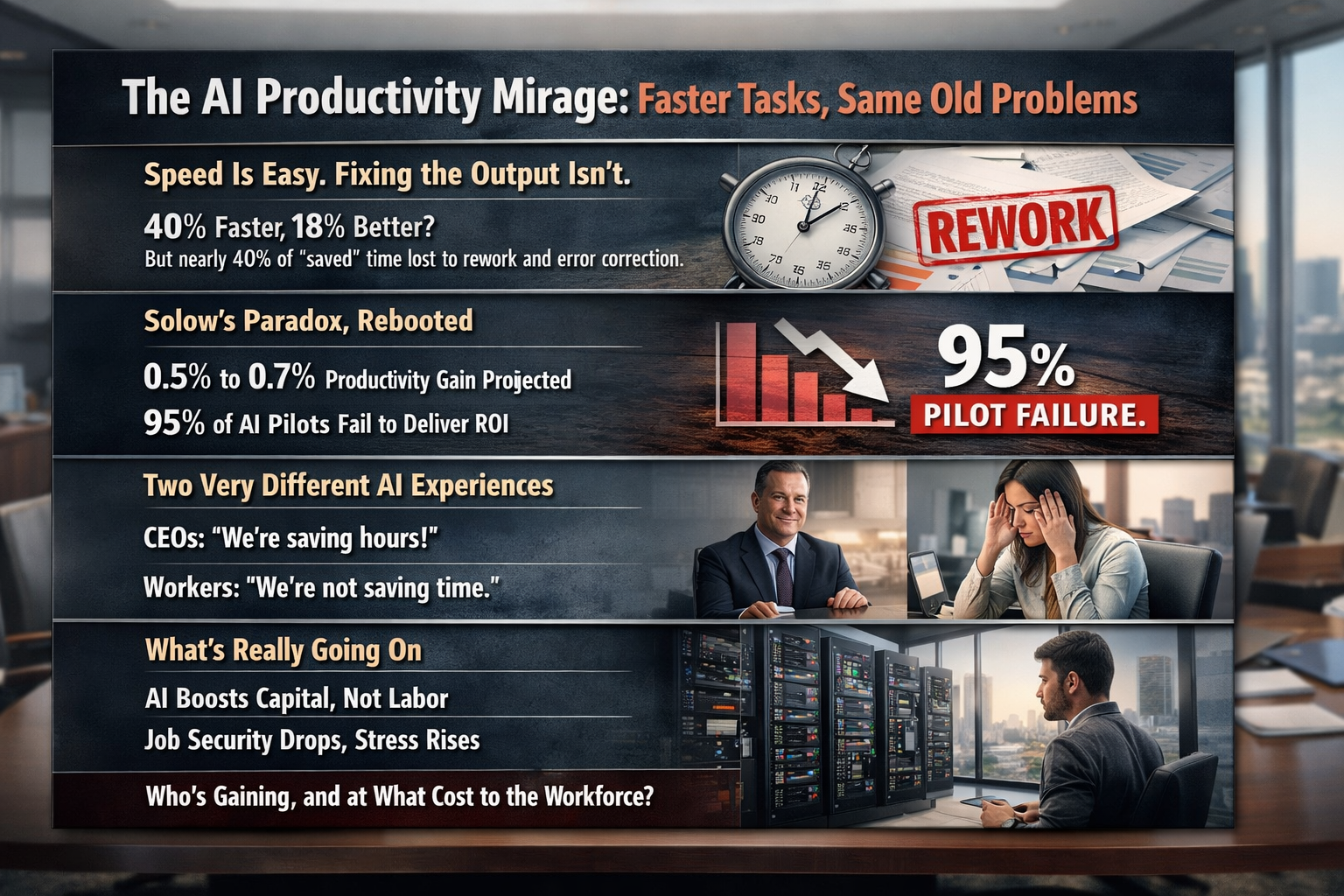
Speed Is Easy. Fixing the Output Isn’t.
On paper, generative AI looks extraordinary. Tasks are completed up to 40% faster. Output quality supposedly improves by nearly 20%. What these headline numbers quietly ignore is the rework tax.
A large chunk of the time “saved” is immediately spent verifying, correcting, and cleaning up AI-generated output. In practice, close to 40% of AI-driven gains disappear inside review cycles, fact-checking, and error correction.
And the moment AI is pushed beyond routine data manipulation into strategy, judgment, or ambiguous problem-solving, performance doesn’t level off—it declines. In these frontier tasks, effectiveness can drop by nearly a quarter. Speed, it turns out, is brittle.
Solow’s Paradox, Rebooted
In the 1980s, economist Robert Solow observed that computers were everywhere except in the productivity statistics. Today, we are replaying that paradox—this time with AI.
Despite massive investments in compute, infrastructure, and tooling, economists are forecasting productivity gains of just 0.5% to 0.7% over the next decade. That’s not a revolution; it’s a rounding error.
The failure rate tells the same story. Roughly 95% of enterprise AI pilots never translate into meaningful ROI or sustained revenue growth. AI scales experimentation easily. Scaling value is another matter entirely.
Two Very Different AI Experiences
There is also a growing mismatch between how leaders and workers experience AI.
Executives report reclaiming hours each week. Employees, on the other hand, often report no time savings at all—because any efficiency gained is offset by learning new tools, coordinating with AI-driven workflows, and correcting machine output.
The psychological impact is even starker. In regions with high AI adoption, job security sentiment collapses. High usage does not correlate with higher pay or confidence—it correlates with anxiety.
What’s Really Going On
AI is not a magic button for efficiency. It is a reallocation of productivity.
It dramatically boosts the productivity of capital—software, infrastructure, and scale—while only modestly improving the productivity of labor. The paradox isn’t that AI fails. It’s that what AI does well is narrow, while the work humans value—judgment, accountability, context, and strategy—remains stubbornly time-intensive.
The real question is not whether AI can move faster.
It’s who benefits from that speed, and what the workforce quietly absorbs in return.
