
The Sound of Silence: What Those “Dead Air” Calls Are Really Doing
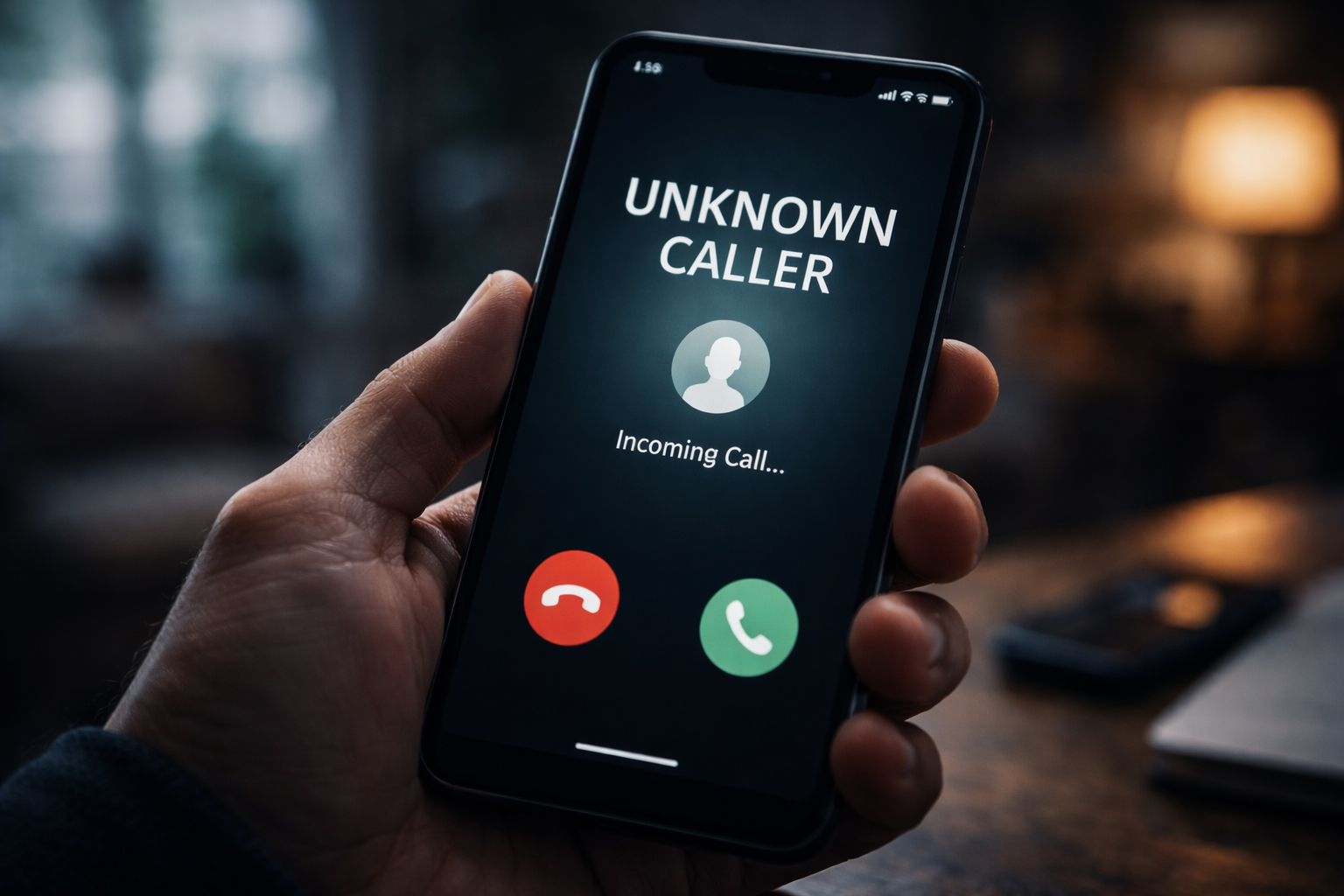
You know the moment. Your phone rings. You answer. Silence. You say “hello.” Nothing. Then—click. The call drops.
It feels like a mistake or a network issue. It isn’t. Consumer protection agencies have documented that many silent or abandoned calls are an intentional part of automated scam operations rather than technical errors (Federal Communications Commission [FCC], 2023; Whittaker, 2020).
Once you understand why it happens, you also understand how to stop it.
The Robot Behind the Call
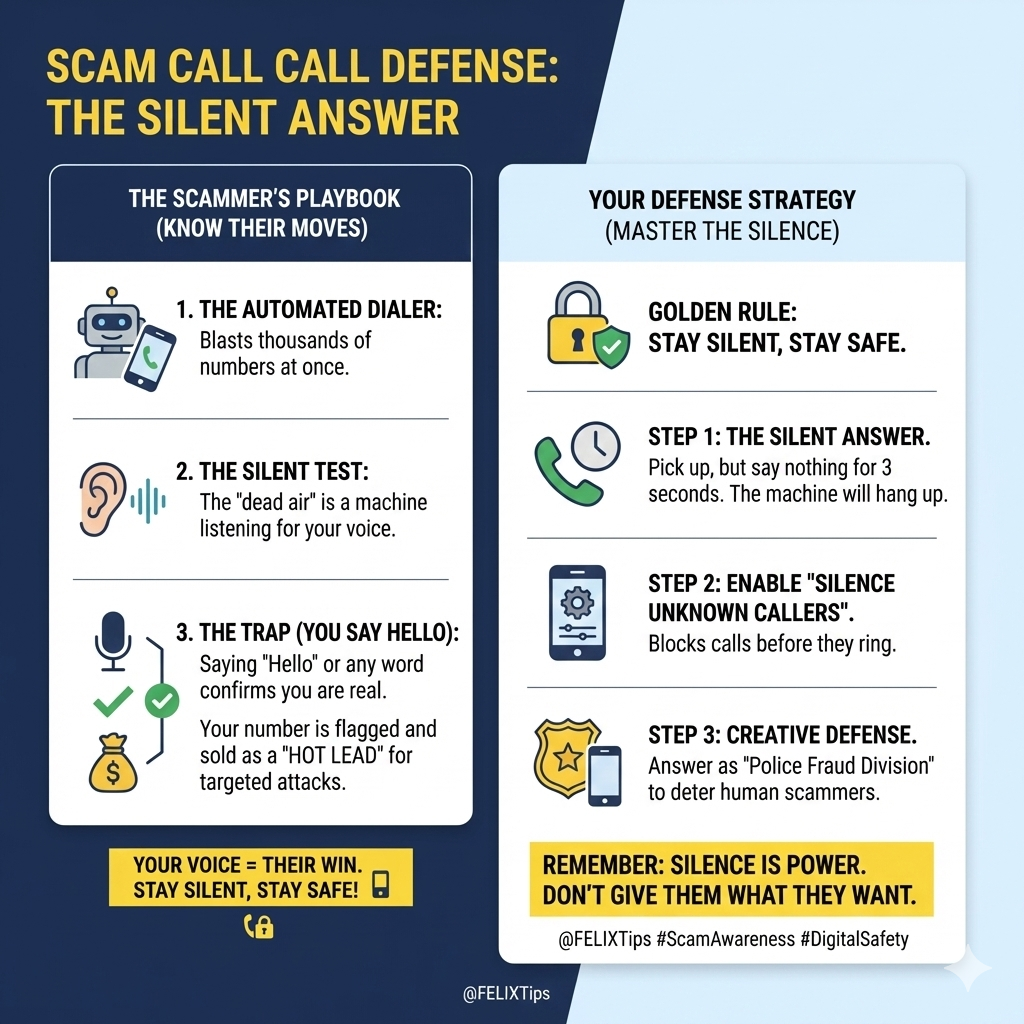
Scammers no longer rely on manual dialing. They use automated systems known as predictive dialers, which place large volumes of calls simultaneously and attempt to connect only answered calls to available human agents (Federal Trade Commission [FTC], 2023).
These systems are designed to minimize idle time for scammers. When no agent is immediately available, the recipient hears silence, or the call is dropped. Regulators classify these as “abandoned calls,” a known byproduct of predictive dialing systems (FCC, 2023).
Silence as a Test
That quiet moment is not passive. Research and enforcement reports show that automated dialers actively listen for human audio to confirm that a number is valid and actively used (FTC, 2022; Whittaker, 2020).
The moment a recipient speaks, the system can mark the number as “live.” Verified numbers are more valuable because they can be reused or sold within scam networks, increasing the likelihood of future targeting (Rao & Reiley, 2012; Truecaller, 2023).
This is why answering—even briefly—can increase the volume of scam calls over time.
How to Break the System
The most effective countermeasure is to deny the system the signal it needs.
Remaining silent prevents the dialer from confirming a live human, which can cause the number to be flagged as unproductive or removed from active rotation (Whittaker, 2020). Allowing calls from unknown numbers to go to voicemail is also strongly recommended by consumer protection agencies, as legitimate callers typically leave messages while scammers rarely do (FTC, 2023).
Modern call-blocking and “silence unknown callers” features further reduce exposure by preventing automated systems from engaging at all (FCC, 2023; Pew Research Center, 2019).
The Bottom Line
Silent scam calls are not random. They are part of a system designed to test, sort, and exploit human responses at scale. Understanding this mechanism shifts the power back to the user.
By staying silent or letting unknown calls go unanswered, individuals reduce the economic value of their phone numbers within scam ecosystems—making them less attractive targets over time (Rao & Reiley, 2012; Truecaller, 2023).
In this case, silence is not just polite. It is strategic.
References
Federal Communications Commission. (2023). Stop unwanted robocalls and texts. https://www.fcc.gov/consumers/guides/stop-unwanted-robocalls-and-texts
Federal Trade Commission. (2023). How robocalls work and how to stop them. https://consumer.ftc.gov/articles/how-stop-robocalls
Federal Trade Commission. (2022). Phone scams. https://consumer.ftc.gov/features/phone-scams
Hann, I. H., Hui, K. L., Lee, S. Y. T., & Png, I. P. L. (2016). Overcoming online information privacy concerns: An information-processing theory approach. Journal of Management Information Systems, 33(2), 447–477. https://doi.org/10.1080/07421222.2016.1205921
Ofcom. (2022). Nuisance calls and messages research. https://www.ofcom.org.uk/research-and-data/consumer-experience/consumer-protection
Pew Research Center. (2019). Americans and their views on robocalls. https://www.pewresearch.org/internet/2019/06/06/americans-and-their-views-on-robocalls/
Rao, J., & Reiley, D. (2012). The economics of spam. Journal of Economic Perspectives, 26(3), 87–110. https://doi.org/10.1257/jep.26.3.87
Truecaller. (2023). Global spam and scam report. https://www.truecaller.com/global-spam-report
Whittaker, Z. (2020). Why scam callers hang up when you answer. TechCrunch. https://techcrunch.com/2020/01/08/why-scam-callers-hang-up/
