
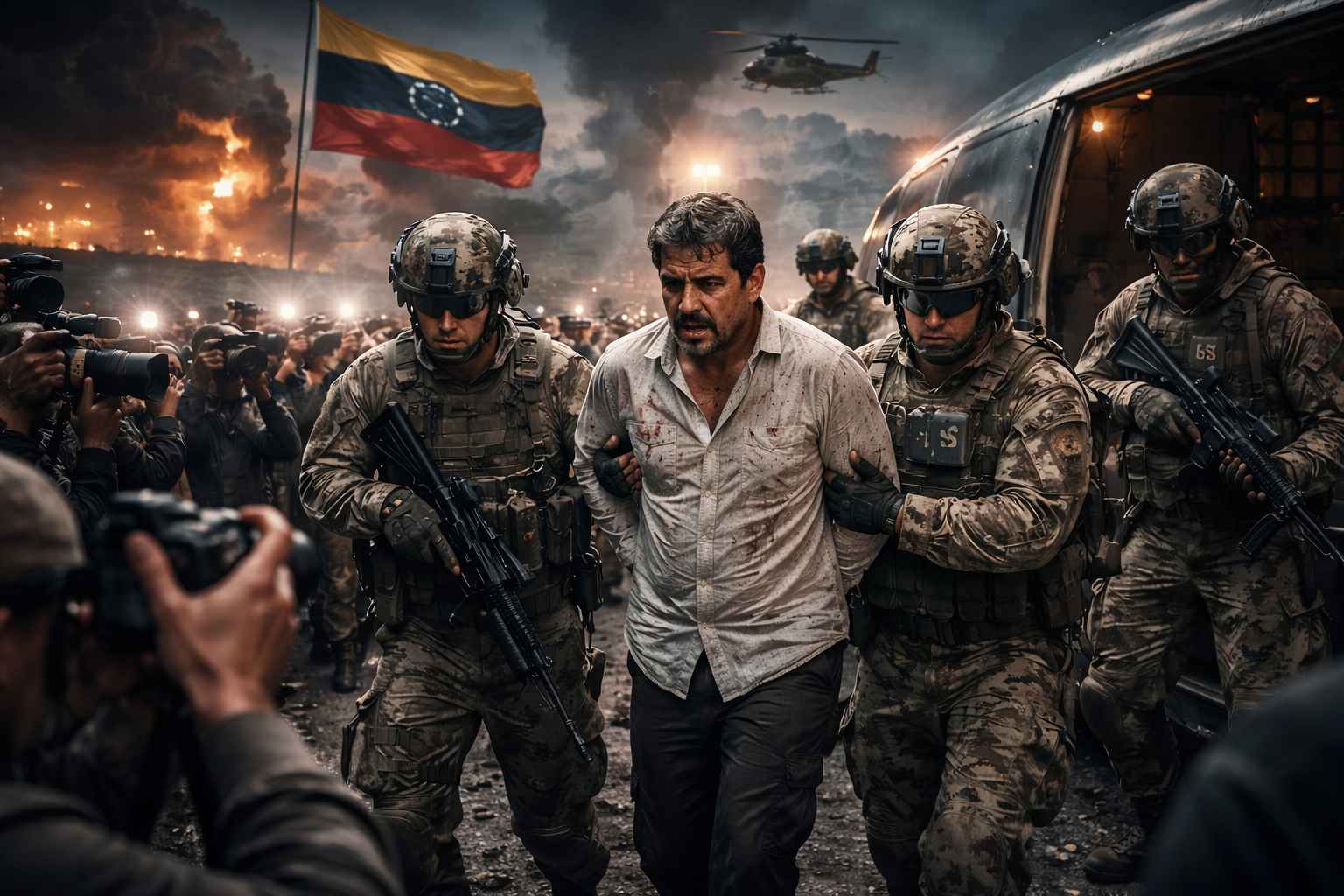
The news that the United States carried out a military operation in Venezuela and captured its president has shaken the world. What Washington calls an act of justice looks more like a serious strategic error that could reshape geopolitics.
1. Using Force Doesn’t Solve the Root Problems
When a country’s leader is removed by force, the result is rarely peace or stability. Many legal and foreign-policy experts argue that the U.S. action violates international law because it did not have United Nations authorization and was carried out without Venezuela’s consent, setting a dangerous precedent for global norms and sovereign rights.
This kind of intervention might strengthen domestic political narratives, but it doesn’t create long-term political solutions in the region. Instead, it risks turning the ousted leader into a symbol of resistance and anti-U.S. sentiment across Latin America and beyond.
2. A Choice Between Competing Global Models
The world today is not shaped by a single global power. Countries in Latin America, Africa, and Asia are increasingly choosing partners who focus on economic cooperation rather than political pressure.
In contrast to the U.S. approach, China and other emerging powers offer investment and development deals without demanding political reform or attaching conditions to internal governance. This shift gives many governments practical reasons to align with non-Western partners rather than rely on Washington’s “missionary” style of diplomacy.
3. Giving China and Others a Strategic Talking Point
Beijing and Moscow reacted strongly to the U.S. action, condemning it as a violation of international law and of Venezuela’s sovereignty. China, in particular, called on the U.S. to respect the principles of the United Nations Charter and warned against one country acting as “world police.”
Such responses reinforce narratives that the U.S. is unilateral and unpredictable, which can strengthen the appeal of alternatives like China’s Belt and Road model that emphasize economic partnership over political intervention.
4. The Broader Consequences: A Region on Edge
This event highlights a deeper strategic problem: the U.S. currently lacks a strong, positive economic strategy in the region to match those of its competitors. Without real investment alternatives to what China offers, coercive approaches risk isolating the U.S. diplomatically and accelerating regional alignment with other powers.
Regional leaders and diplomats have expressed serious concerns about wider instability, potential humanitarian crises, and the undermining of political processes that should ideally be resolved internally through negotiation and elections, not external force.
In Summary*
Arresting a foreign head of state by force might play well in certain political circles, but it doesn’t address the deeper economic, diplomatic, and strategic realities of the 21st century. The world is more multipolar than ever, and states are increasingly sensitive to actions they see as violations of international norms and national sovereignty.
Unless the United States can offer a model grounded in cooperation, investment, and respect for international law, it risks winning headlines while losing influence in key regions.
References
- Mearsheimer, J. J. (2018). The Great Delusion: Liberal Dreams and International Realities. Yale University Press.
— Foundational analysis of why coercive liberal interventionism often backfires. - Walt, S. M. (2018). The Hell of Good Intentions: America’s Foreign Policy Elite and the Decline of U.S. Primacy. Farrar, Straus and Giroux.
— Explains how force-based foreign policy erodes long-term U.S. influence. - Pape, R. A. (2005). Dying to Win: The Strategic Logic of Suicide Terrorism. Random House.
— Empirical evidence on how coercion and occupation create martyrs and resistance. - International Crisis Group. (Various reports). Latin America and the Caribbean Briefings.
— Ongoing analysis of regional reactions to external intervention and sovereignty concerns. - United Nations Charter, Articles 2(4) and 51.
— Legal framework governing sovereignty, use of force, and international legitimacy. - Farrell, H., & Newman, A. L. (2019). “Weaponized Interdependence.” International Security, 44(1), 42–79.
— Explains how economic and legal tools replace traditional military leverage. - Rachman, G. (2022). The Age of the Strongman. Bodley Head.
— Contextualizes leader-centric politics and how external pressure strengthens them domestically. - The Diplomat.
— Coverage on China–Latin America relations, infrastructure diplomacy, and non-conditional engagement. - Council on Foreign Relations (CFR).
— Backgrounders on U.S.–Latin America relations, sanctions policy, and regional alignment trends. - World Bank & Inter-American Development Bank (IDB).
— Data on infrastructure financing, development priorities, and regional economic needs. - Nye, J. S. (2004). Soft Power: The Means to Success in World Politics. PublicAffairs.
— Conceptual basis for attraction vs coercion in global influence. - BRICS Policy Center (PUC-Rio).
— Analysis of Global South alignment patterns and post-unipolar world dynamics.
