
Technology moves fast.
And when it moves, it doesn’t wait for anyone.
Not long ago, Nokia, BlackBerry, LG, and HTC ruled our pockets. These weren’t just phone brands. They were in the smartphone industry. But within a few short years, they were pushed aside by a shift they didn’t fully see—or didn’t act on in time.
Their story teaches one hard lesson:
Past success does not protect you from the future.
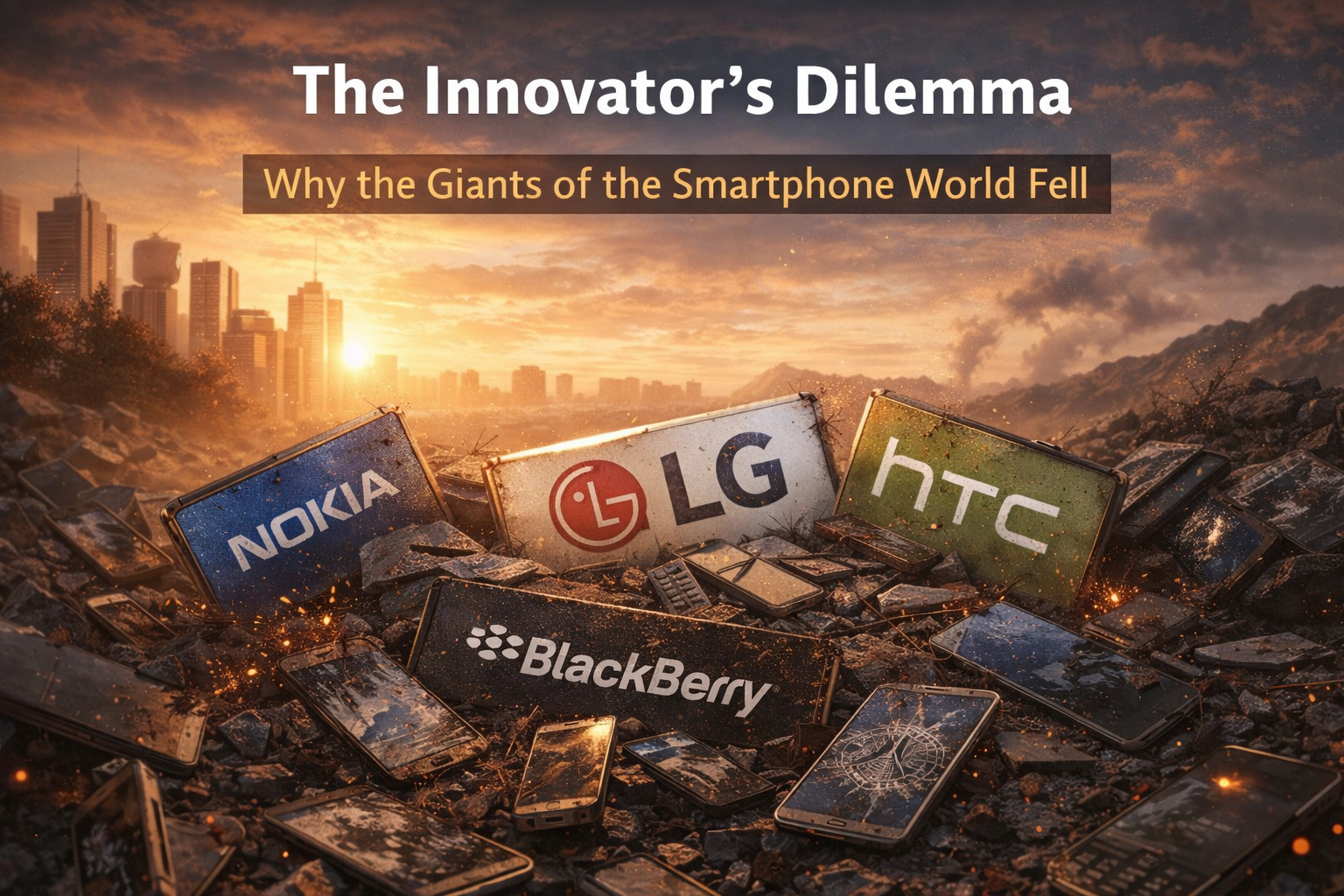
When Identity Gets Lost: LG and HTC
Some companies didn’t fail because they lacked ideas.
They failed because they lacked focus.
LG was bold and experimental. Back-mounted buttons. Swivel screens. Modular designs. But there was no clear story. Was LG premium? Affordable? Experimental? All of the above meant none of the above. Customers couldn’t tell what LG stood for, so they stopped choosing it.
HTC helped create Android itself. Their phones were beautifully built, especially the HTC One M7, which felt premium before the term “premium” became common. But HTC whispered while Apple and Samsung shouted. Great products don’t survive if no one hears about them.
The Software Blind Spot: Nokia and BlackBerry
Nokia and BlackBerry dominated the world—but in different ways.
Nokia owned global scale.
BlackBerry owned professionals.
Both believed hardware strength would always matter most.
They were wrong.
Nokia’s phones were powerful, but Symbian was built for button presses—not touch-first apps. As smartphones became software platforms, Nokia couldn’t adapt fast enough.
BlackBerry believed secure email was the killer feature. But people didn’t want two devices—one for work and one for life. They wanted one phone that did everything. Apps, photos, games, browsing, and work—together.
Software won. Ecosystems won. Simplicity won.
What the Fallen Giants Teach Us
Three lessons still matter today:
- Software ecosystems matter more than hardware.
The experience around the device is the product. - Success can blind innovation.
When a formula works too well, companies resist changing it. - Clarity beats complexity. The merging of brand, message, and user experience is non-negotiable.
Some of these companies survived by reinventing themselves.
BlackBerry shifted into cybersecurity.
LG returned to its strengths in home technology.
But their exit from smartphones marked the end of an era—
a time when the industry was wild, experimental, and uncertain.
And that uncertainty is exactly where the next disruption always begins.
References (published sources)
- Christensen, C. M. (1997). The Innovator’s Dilemma. Harvard Business School Press.
- West, J., & Mace, M. (2010). Browsing as the killer app: Explaining the rapid success of Apple’s iPhone. Telecommunications Policy, 34(5–6), 270–286.
- Isaacson, W. (2011). Steve Jobs. Simon & Schuster.
- Gawer, A., & Cusumano, M. A. (2014). Industry platforms and ecosystem innovation. Journal of Product Innovation Management, 31(3), 417–433.
- Kenney, M., & Pon, B. (2011). Structuring the smartphone industry. Journal of Industry, Competition and Trade, 11, 295–321.
