
What we’re watching in AI right now is not confident leadership or long-term vision. It’s panic—raw, exposed, and increasingly public. Beneath the breathless announcements and bold claims, today’s AI boom is defined less by innovation and more by leaders scrambling to stay relevant in a market that punishes hesitation and rewards noise.
This is corporate warfare under existential pressure, where standing still is fatal, and every move feels reactive.
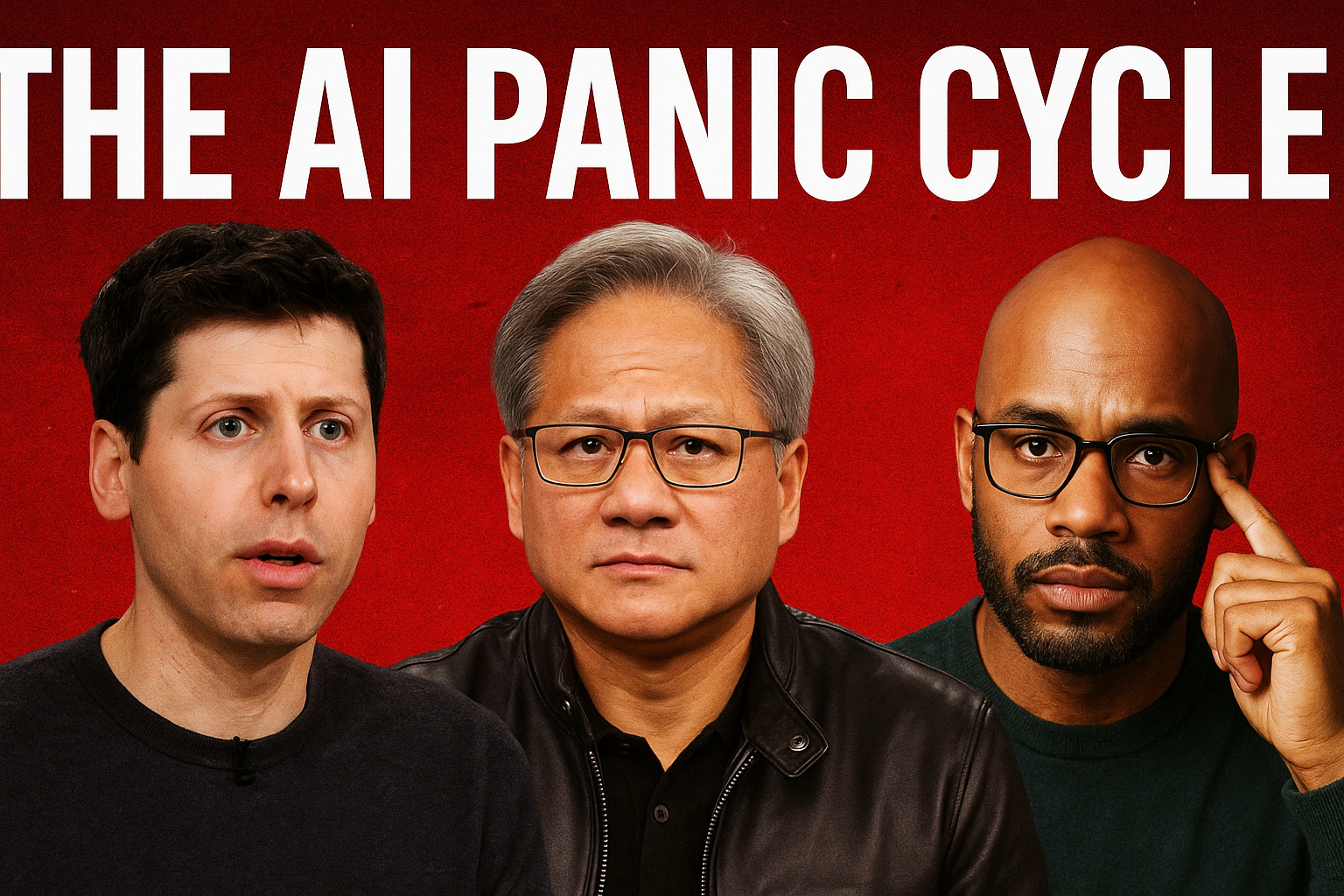
The Prophet in Panic: OpenAI’s Vibe Pivot
OpenAI was once the uncontested catalyst of this cycle. Today, it looks defensive.
As Google’s Gemini steadily eats into engagement, OpenAI’s response hasn’t been a decisive technical leap—it’s been a media blitz. When a CEO declares “code red” and then shows up on late-night television, that’s not product confidence; that’s narrative management.
This pivot exposes a hard truth: benchmarks no longer anchor public trust. Vibes do. OpenAI now understands that perception, not technical superiority, sustains attention. That makes ChatGPT less of a technical moat and more of a cultural brand—one whose stability depends on celebrity, narrative, and constant relevance. That’s a fragile foundation for something marketed as the future of intelligence.
The Hardware King as Political Pawn: Nvidia
Nvidia’s dominance looks unshakeable—until geopolitics enters the room.
Jensen Huang’s constant shuttling between Washington, Beijing, and speculative new markets isn’t confidence; it’s damage control. U.S. restrictions on advanced chip exports to China didn’t just hurt revenue—they exposed how dependent Nvidia’s supremacy is on political permission.
Strip away the hype and Nvidia’s future rests on two unstable pillars: hyperscaler spending and geopolitical goodwill. Neither is guaranteed. The result is a company leading the AI infrastructure race while being fundamentally constrained by forces it cannot engineer its way out of.
Vibe Coding and the Race to the Bottom
The Google Cloud–Replit partnership signals where the industry is really heading—and it’s not toward rigor.
Google doesn’t need Replit technologically. It needs Replit’s funnel. “Vibe coding” isn’t about better software; it’s about scale—onboarding non-technical users in HR, marketing, and sales who want internal tools without engineers. The code just needs to exist, not endure.
By legitimizing this model, the industry is quietly redefining software development as a disposable commodity. Depth, robustness, and maintainability are sacrificed for accessibility and growth metrics. It’s a short-term win for hyperscalers—and a long-term risk for everyone else.
The Real Question No One Is Answering
This entire cycle—media tours, political lobbying, low-bar tooling—is driven by a single fear: consolidation is coming, and only a few will survive it.
Executives boast about growth, demand, and dominance, but their behavior tells another story. Panic marketing replaces product leadership. Partnerships replace principles. Hype replaces durability.
The unanswered question isn’t who’s winning today. It’s which of these companies still stands when the noise fades, the politics shift, and the market demands something sturdier than vibes.
