
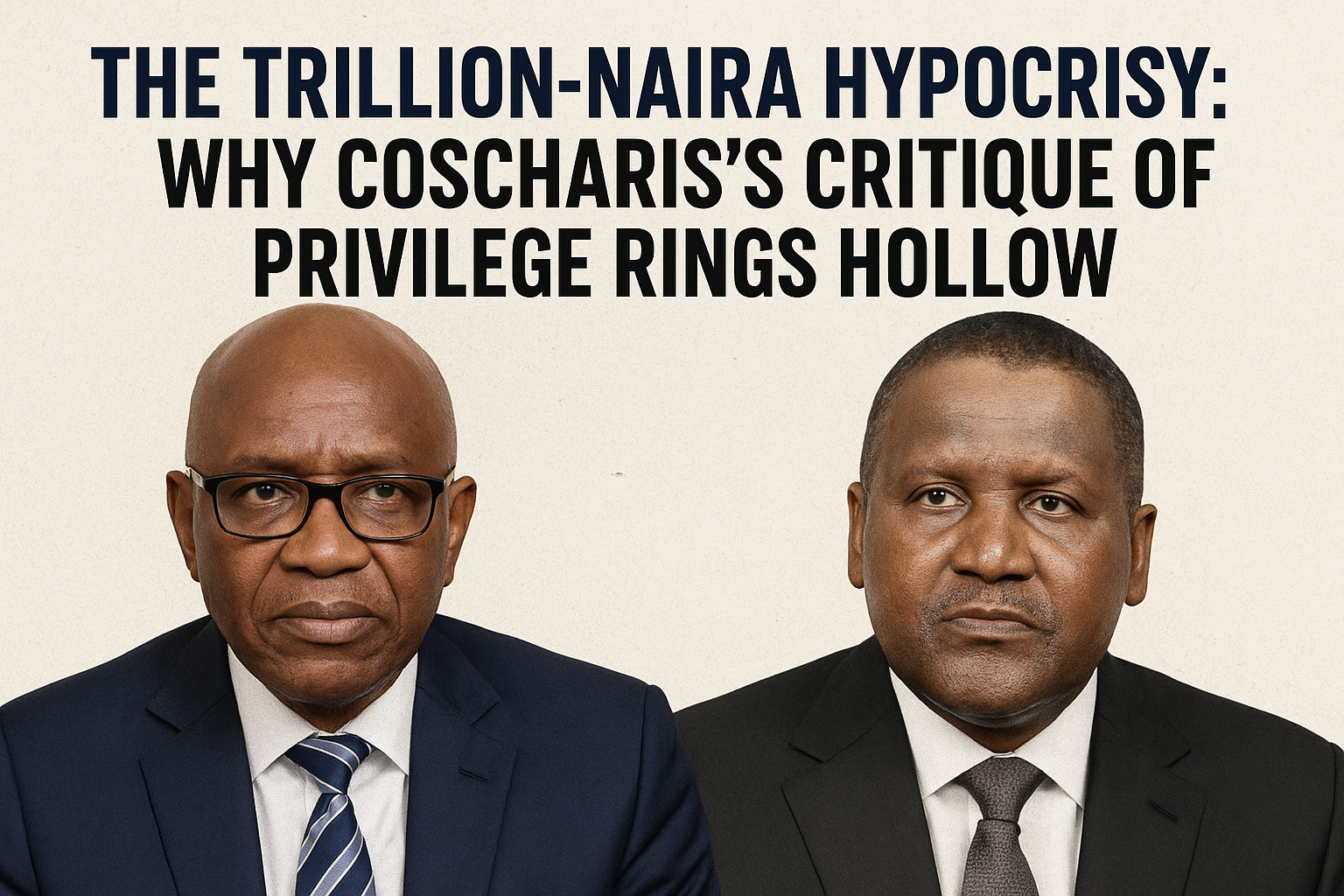
Dr. Cosmas Maduka, Chairman of Coscharis Group, is an undisputed Nigerian success story. His journey—from humble beginnings to leading a multi-sector conglomerate—is a testament to entrepreneurial grit. Yet, his public critique regarding the nature of wealth creation in Nigeria is a masterclass in elite self-contradiction.
In a recent video, Maduka starkly contrasted his wealth today with that of Aliko Dangote, claiming that the disparity exists because wealth is not built on merit but on political privilege, licenses, and monopolies. While his call for a “level playing field” sounds noble, his argument is fatally undermined by one uncomfortable fact: his own empire was built by mastering the very system he now condemns.
This isn’t a call for meritocracy; it’s a lament from an elite player who couldn’t secure the top-tier access enjoyed by the apex godfathers.
I. The Myth of the Suppressed Genius
Maduka bases his premise on a painful personal contrast:
Maduka’s Claim: “In 1985 or 88, by the Concord newspaper, I was voted as the No. 1 businessman. Dangote was No. 2. Compare my wealth with Dangote’s today. Dangote can write one cheque and buy everything I have.”
The Critical Rebuttal: This comparison is a self-serving half-truth. Maduka’s initial success in the 80s, where he was ranked highly alongside Dangote, occurred within the same politically controlled, license-dependent import economy. His early standing proves he was an exceptional player within that system. The massive subsequent gap is less about malicious suppression and more about differing risk profiles.
Dangote shifted from trading to massive, capital-intensive manufacturing (cement, refinery) with enormous government backing and political risk protection (the very definition of monopoly). Maduka, by contrast, grew Coscharis through diversified trade, assembly (automobiles), and services. The current wealth gap is a consequence of two different business models: one built on high-risk national monopolies, the other built on exploiting consumer markets. Maduka is critiquing the destination after choosing a different road.
II. The Hypocrisy of the Import License
The centerpiece of Maduka’s argument is his critique of the arbitrary privilege enjoyed by rivals:
Maduka’s Claim: “There are privileges that people enjoy. Import license. Femi Otedola, at one time, had to import only diesel into this country… Nobody creates a monopoly for you so that you cannot become a multi-billionaire.”
The Critical Rebuttal: This is the height of elite hypocrisy. Dr. Maduka, as Chairman of Coscharis, runs a conglomerate dealing heavily in luxury automobile importation, assembly, and trade. His entire business model relies on navigating and securing favorable government policies, import licenses, and waivers within a highly protectionist state.
His criticism of Otedola for having an exclusive license to bring in diesel is disingenuous; he is critiquing the scope of the monopoly, not the principle of politically granted access. Maduka is not asking for the system to be dismantled; he is lamenting that the specific license granted to Otedola was more valuable than the licenses that built his own luxury car empire. His success is proof that privileged access exists, not proof that merit prevails.
III. The Flawed Diagnosis: Conflating Merit with Ethnic Politics
Maduka correctly identifies the tragedy of Nigeria’s waste but misdiagnoses the cause:
Maduka’s Claim: “We are asking you to give us a level playing field… This federal character is the problem… Until we have a country that is based on equity and the best brains, we will never make any progress as a nation.”
The Critical Rebuttal: Maduka conflates political balancing mechanisms with the fundamental issue of economic capture. He attacks “Federal Character” (the quota system meant to manage ethnic representation) as the primary problem. While Federal Character is a flawed tool that often sacrifices competence for diversity, it is a symptom of political mistrust, not the cause of economic corruption.
The true source of the stifled economy is the monopoly licensing system he himself utilized to build his wealth. The economic solution is transparency, not just removing ethnic quotas. Maduka calls for “equity and best brain” only after securing his own position by exploiting the unequitable environment of government-controlled trade licenses.
Conclusion: The Limits of the Lament
Maduka’s lament is a tragic mirror reflecting the Nigerian political economy. He represents the class of entrepreneurs whose potential was undeniably enormous but whose growth trajectory was ultimately limited by the fact that they lacked the ultimate political capital to transition from the business elite to the monopoly godfather.
His call for a “level playing field” is noble in its message but hypocritical in its source. The field was never level for him, just as it was never level for Dangote, and his empire is proof of that fact. The truth is, the true struggle is not just about bringing in the “best brain,” but about dismantling the structure of privileged access that continues to benefit figures like Maduka himself while keeping millions of truly unconnected Nigerians out of the game entirely.
To watch the video, kindly click https://surl.lu/hpcjik
