
Do you remember 2008? The electricity? The feeling that politics had finally woken up from its long sleep? When Barack Obama ran on Hope and Change, it wasn’t just branding. It felt like permission to believe again.
Then he won.
And reality punched back.
An obstructionist Senate. Corporate lobbying with tentacles everywhere. A political architecture engineered to protect the status quo. For many of us, that era didn’t just disappoint—it reshaped our political psychology. We learned that idealism doesn’t get crushed by bad people. It gets crushed by the system—that self-healing machine built to keep things exactly as they are.
And now, years later, in a totally different arena, we’re watching that same movie again. This time in New York City. This time with Zohran Mamdani.
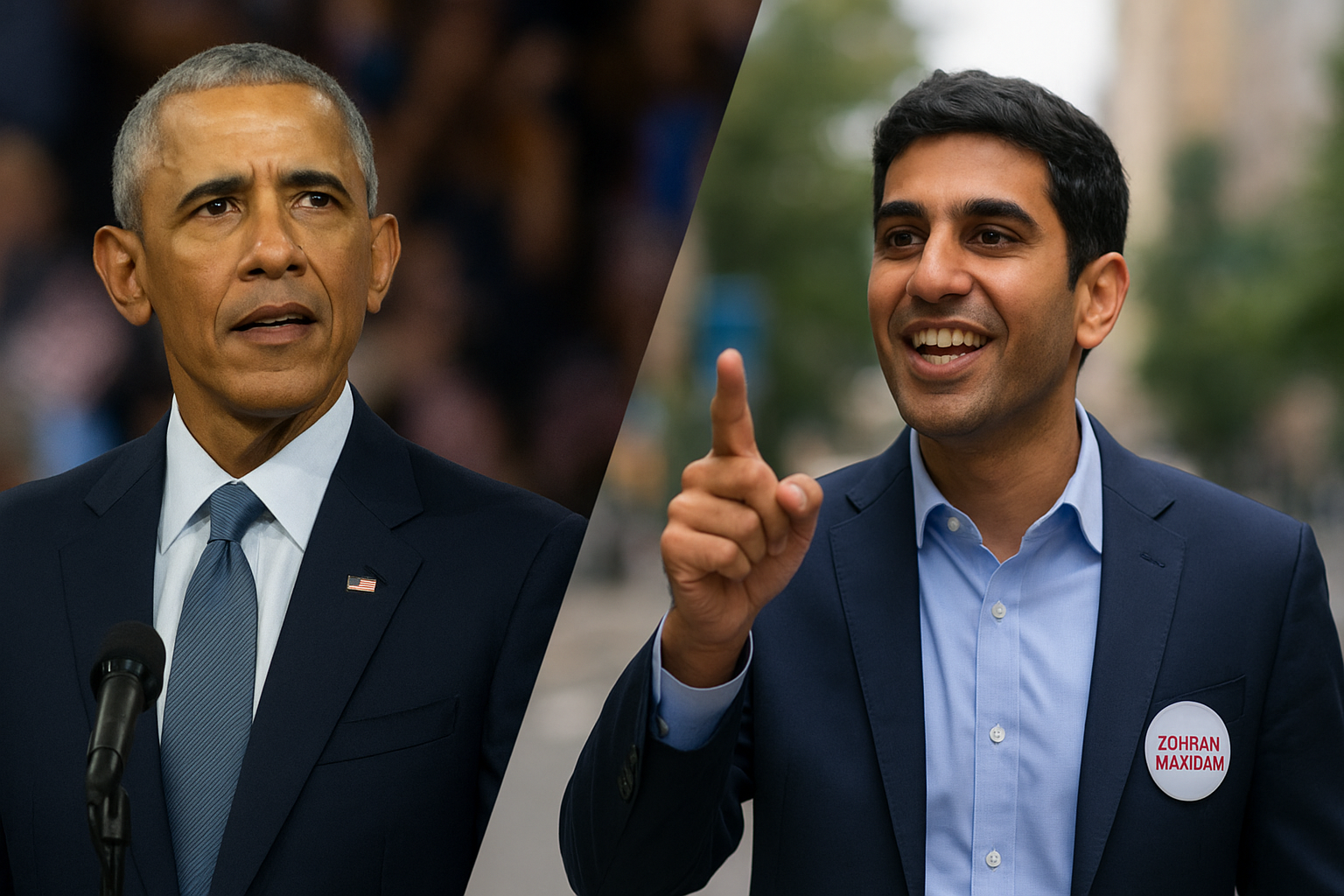
A Familiar Spark in a Different Borough
Mamdani is running a campaign that feels like someone localized Obama’s 2008 electricity, stripped it down, and ran it through a Brooklyn amplifier. No boardrooms. No polish. He’s walking the Brooklyn Bridge. Dancing in the street. Talking to taxi drivers. He’s not a candidate of institutions—he’s a candidate of sidewalks.
And he’s not nibbling around the edges. He’s promising a full-on structural renovation of the city:
- A rent freeze
- Government-run grocery stores
- Universal childcare
- Free public transit
It’s bold. It’s maximalist. It’s the kind of politics people turn toward when they’re tired of being told to “manage decline.”
Predictably, the establishment is reacting like someone threw water on a live electrical panel.
The Machine Awakens
The “system” isn’t one villain. It’s a whole ecosystem of veto points.
1. The Political Gatekeepers
Start with the party machine.
Hakeem Jeffries gives a late, grudging endorsement—reportedly after trying to extract a promise that Mamdani wouldn’t back a challenger against him.
Abigail Spanberger dismisses his platform with a condescending smirk:
“I couldn’t ever pass it. People don’t want us to lie to them.”
It’s the same message we’ve heard for decades:
Real adults don’t dream. They manage. They trim. They nibble.
Translation:
“Don’t aim high. The system won’t let you.”
2. The Capital Machine
But the political machine is just the receptionist.
The real boss is capital.
New York’s financial structure is a fortress:
- Albany controls the funding, and Albany has zero interest in underwriting free public transit or childcare.
- The city is so dependent on billionaires that losing a couple dozen could break the budget.
- Real estate is “cartel-controlled”, rendering rent reform a herculean task.
- The city’s priorities are engineered to “make it a playground for the global super elite.”
Mamdani isn’t just campaigning.
He’s trying to rewire a skyscraper while it’s still plugged into Wall Street.
The Obama Echo: Naivety or Necessary Hope?
One commentator in the text says it plainly:
“If you lived through Obama, you know how this story ends.”
The sentiment is understandable. Hope didn’t just disappoint—it scarred a generation. Many young people backing Mamdani haven’t felt that burn yet. They actually believe the government will lower their rent. They think structural change is possible. And to some veterans of political heartbreak, that optimism looks naive.
But there’s another argument—one that hits harder.
Maybe people don’t expect miracles. Maybe they just want to see someone fight for what they actually believe.
Bill de Blasio didn’t have a movement like Mamdani’s. He had less leverage, fewer allies, and an openly hostile governor. Yet he still delivered universal Pre-K—one of the most transformative social policies New York has seen in decades.
So maybe this isn’t about naïve idealism.
Maybe it’s about conviction paired with infrastructure—a candidate backed by a coalition large enough to make obstruction expensive.
The Real Test
Mamdani’s campaign forces us to confront a deeper question:
Is it better to be a “realistic” centrist who promises nothing because the system won’t allow it—
or an idealist who shoots for the moon knowing you’ll be fought at every step, but might still drag the world an inch forward?
Obama taught us how systems fight back.
Mamdani may teach us whether movements can fight harder.
Either way, this moment is a referendum on the politics of possibility.
Not on what’s realistic—but on whether we’re willing to believe again, even after disappointment.
If idealism is a trap, it’s one we keep walking into.
Not because we’re naive—
but because deep down, we know nothing worth building ever came from managing decline.
