
The Yoruba Approach to Marital Vetting
In traditional Yoruba society, marriage was rarely treated as a private arrangement between two individuals. It was a union involving families, relationships, obligations, values, and expectations that could extend across generations.
Before an engagement was finalized, families could consult a Babalawo and undertake Ifá divination as part of the broader process of seeking guidance about the proposed union.
Viewed from a modern perspective, there is an interesting function embedded in this practice.
The purpose was, among other things, to seek information about potential difficulties before an irreversible commitment was made.
That is not the same thing as saying that Ifá was a statistical risk-management system. It was a religious and cultural system with its own epistemology, practices, and meaning.
But functionally, there is a question worth asking:
How do we identify significant incompatibilities before two people make a lifelong commitment?
That question has not disappeared.
Only the method has changed.
Today, couples often rely on romantic attraction, conversations, family advice, counseling, personality tests, and premarital questionnaires.
The problem is that people do not necessarily reveal their behavioral patterns during courtship.
They may not even be deliberately hiding them.
People naturally present their best selves when a relationship is still new. They are more patient. More attentive. More accommodating. Conflict is often limited because the relationship has not yet accumulated the pressures that expose deeper differences.
Financial habits, responses to stress, conflict-recovery patterns, family boundaries, household expectations, and emotional regulation often become clearer only after commitment.
This creates what I would describe as courtship masking.
The question, therefore, is not whether we can find a perfect compatibility score.
The question is whether we can build a better measurement system for identifying relational risk before commitment.
Why Modern Questionnaires Can Miss the Signal
Most premarital assessments depend heavily on questionnaires.
Couples answer questions. A counselor or assessment system scores the responses. The results are discussed.
There is value in this approach.
But it has a fundamental limitation.
It measures what people report about themselves at a particular point in time.
Three problems immediately emerge.
- Social Desirability Bias
People do not always answer questions according to their actual behaviour.
Asked how they handle conflict, someone may describe how they believe a healthy partner should behave rather than how they actually behave when angry.
They describe the person they want to be.
That is not necessarily the person their partner experiences.
- Retrospective Recall Bias
Memory is not a perfect recording system.
A disagreement that felt serious three months ago may seem less important when remembered after the couple has reconciled.
Over time, people remember the resolution more clearly than the pattern that produced the conflict.
A questionnaire therefore risks measuring reconstructed memory rather than real-time experience.
- Disagreement Is Not Noise
This may be the most important issue.
Suppose one partner rates financial alignment as 5 out of 5, while the other rates it 2 out of 5.
A conventional assessment might average those responses and produce a score of 3.5.
That looks reasonable.
But the average hides the most important information.
The partners do not experience their financial relationship in the same way.
That disagreement is not necessarily measurement error.
It may be the diagnosis.
Continuous Telemetry Instead
Instead of asking a couple to describe their relationship once, imagine measuring selected aspects of their experience repeatedly over a defined period.
For example, both partners could independently record daily ratings for 30 days.
They would not see each other’s responses during the measurement period.
The objective is not surveillance.
It is to reduce the pressure to produce a coordinated answer and capture patterns while they are happening.
Thirty days of observations will not reveal the entire truth about a relationship.
No measurement system can do that.
But it can reveal patterns that a single questionnaire is unlikely to capture.
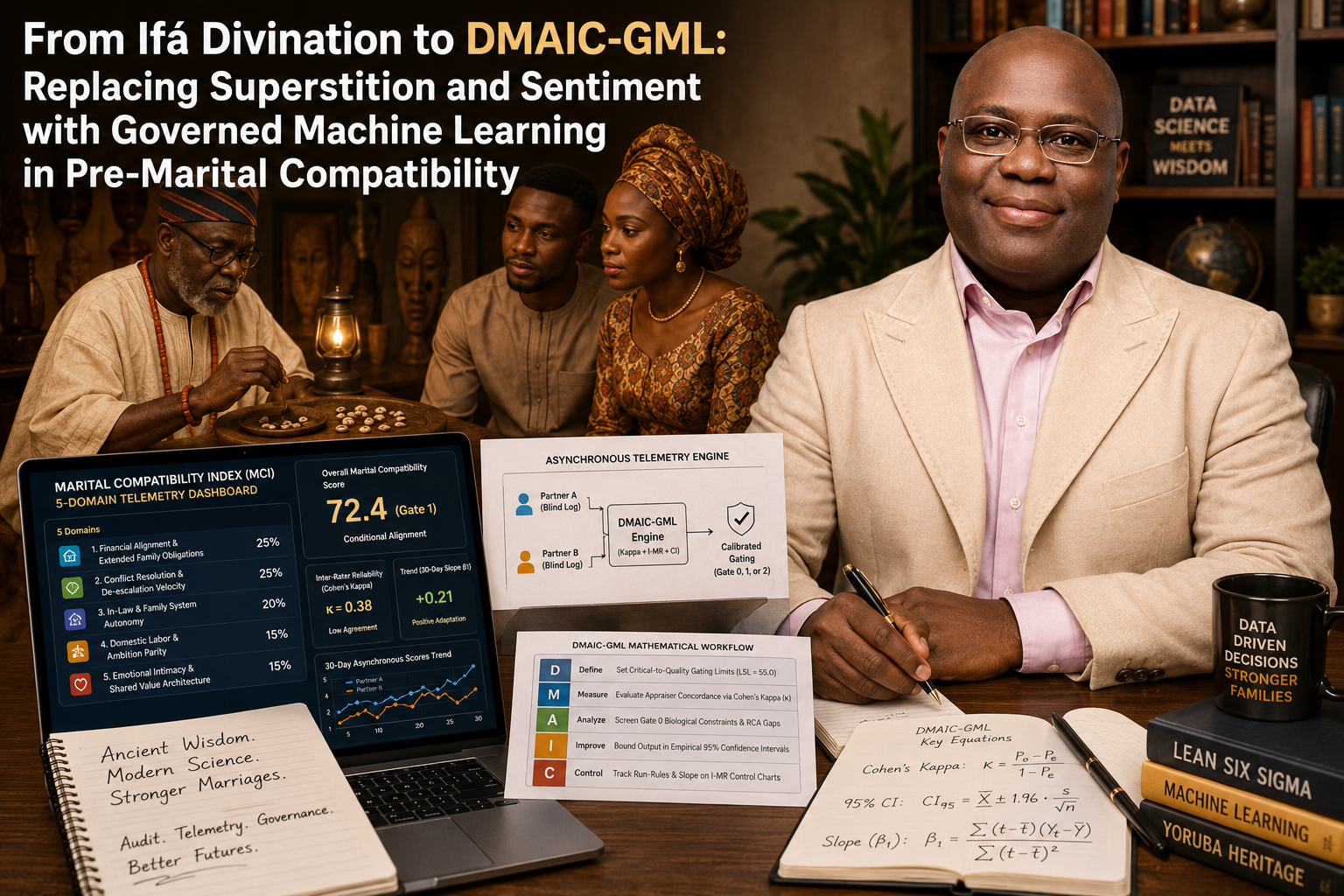
The proposed Marital Compatibility Index (MCI) uses this longitudinal approach across five domains.
The Five Domains
- Financial Alignment and Extended Family Obligations — 25%
Budget transparency, attitudes toward debt, spending priorities, financial planning, and expectations around financial support for extended family.
- Conflict Resolution and De-escalation — 25%
How disagreements develop, how long conflict persists, how quickly repair attempts occur, and whether destructive behaviours such as contempt or prolonged withdrawal appear.
- Family Boundaries and Couple Autonomy — 20%
The ability of the couple to establish and maintain appropriate boundaries with parents, siblings, relatives, and other external influences.
- Domestic Equity and Ambition Alignment — 15%
Perceptions of fairness in household responsibilities, career priorities, workload, and expectations about who does what.
- Emotional Intimacy and Shared Values — 15%
Emotional safety, vulnerability, shared values, communication, and the ability to discuss difficult issues without fear of rejection.
Each partner independently records a daily rating on a 1–5 scale.
Over time, the assessment produces a longitudinal record rather than a single snapshot.
That difference matters.
Governing the Data: DMAIC-GML
Collecting more data does not automatically produce better decisions.
Human behavioural data is noisy.
People change from day to day. Perceptions change. Circumstances change. A stressful workday can affect how someone experiences an otherwise ordinary interaction.
Machine learning applied to this type of data therefore needs more than a prediction algorithm.
It needs governance.
This is where DMAIC-GML enters the framework.
DMAIC-GML applies the principles of Define, Measure, Analyze, Improve, and Control to the development and governance of machine-learning-based assessment.
The objective is not to build an algorithm that declares whether two people are “compatible.”
The objective is to create a controlled decision-support process that identifies patterns, uncertainty, disagreement, instability, and areas requiring further attention.
The Five Phases
Define: Establish the Decision Boundaries
The first principle is simple:
Do not change the rules after seeing the results.
The framework, therefore, defines its critical-to-quality requirements and provisional decision boundaries before analysing the data.
The current conceptual model uses three provisional gates:
- Gate 0: Significant Risk—composite score below 55.
- Gate 1: Conditional Alignment — score from 55 to below 80, indicating areas requiring targeted discussion or intervention.
- Gate 2: Strong Alignment — score of 80 or above, subject to statistical stability and other assessment requirements.
These values should not be treated as universal truths.
They are provisional specification limits for the research framework.
Their eventual validity must be established empirically through pilot data, criterion validity, sensitivity analysis, and outcome studies.
In other words, the research must earn the thresholds.
The numbers should not simply be assumed to be correct because they appear precise.
Measure: Agreement Is a Signal
The framework does not simply average Partner A’s score with Partner B’s score.
Instead, it examines the degree of agreement between their assessments.
For categorical or appropriately categorized observations, Cohen’s Kappa can be used to assess inter-rater agreement.
For the 1–5 ordinal scale proposed here, a weighted Kappa approach is more appropriate because disagreement between a rating of 5 and 4 is not equivalent to disagreement between 5 and 1.
A simplified expression of Kappa is:
[$$\kappa = \frac{P_o-P_e}{1-P_e}$$]
where (P_o) represents observed agreement and (P_e) represents agreement expected by chance.
The purpose is not to declare that a particular Kappa value automatically means a relationship will fail.
Instead, low agreement becomes a diagnostic signal.
If one partner consistently experiences a domain very differently from the other, that difference deserves investigation.
The disagreement itself may identify a hidden process problem.
Analyze: Find the Pressure Points
Once measurement quality has been examined, the next question is:
Where is the variance coming from?
Is the primary problem financial expectations?
Conflict recovery?
Extended-family boundaries?
Domestic responsibilities?
Emotional intimacy?
The framework therefore moves from the overall score to the individual domains.
This is where Root Cause Analysis becomes useful.
A high-level compatibility score can tell us that something is wrong.
Root Cause Analysis should help determine what is wrong and where to look next.
Where appropriate, other relevant screening information may also be considered separately.
For example, biological or genetic considerations that have established clinical relevance should not be treated as another arbitrary component of a relationship score. They should be handled through appropriate clinical assessment and professional counselling.
The objective is to prevent the machine-learning model from pretending that every important decision can be reduced to a single number.
Improve: Account for Uncertainty
Thirty days of observations will produce more information than a single questionnaire.
It will also produce more noise.
That noise must be measured.
The framework therefore considers the mean, standard deviation, dispersion, and uncertainty surrounding the observed scores.
A basic confidence interval can be expressed as:
[$$\text{CI}_{95} = \bar{X} \pm 1.96\left(\frac{s}{\sqrt{n}}\right)$$]
However, there is an important qualification.
Daily observations are not necessarily independent.
Today’s relationship experience may be influenced by yesterday’s experience.
That means a simple textbook confidence interval may underestimate uncertainty if temporal dependence is ignored.
As the framework develops, the analysis should therefore examine approaches appropriate for repeated and longitudinal observations, including autocorrelation, repeated-measures structures, bootstrap methods, or other suitable statistical techniques.
The principle is straightforward:
Do not give people a precise-looking number when the underlying measurement is uncertain.
Control: The Trajectory Matters
A relationship is not a static process.
That means the direction of the measurements matters.
Imagine two couples with the same average score.
Couple A begins at 2.8 and gradually improves to 4.2.
Couple B begins at 4.3 and gradually declines to 2.9.
Their average scores could be surprisingly similar.
Their trajectories are not.
The proposed MCI therefore examines longitudinal behaviour.
An Individual and Moving Range (I-MR) control chart can help distinguish ordinary variation from unusual variation when its assumptions and implementation are appropriate.
A regression slope can also provide a simple measure of trajectory:
[$$\beta_1 = \frac{\sum_{t=1}^{n}(t-\bar{t})(Y_t-\bar{Y})}{\sum_{t=1}^{n}(t-\bar{t})^2}$$]
A positive slope may indicate improvement in the measured domain.
A negative slope may indicate deterioration.
But even here, the framework should avoid simplistic conclusions.
A positive slope does not automatically mean a healthy relationship, just as a negative slope does not prove that a relationship should end.
The trajectory is a signal for investigation, not a verdict.
From Compatibility Scores to Decision Support
This distinction is critical.
The MCI should not become a machine that tells people:
“You should marry.”
or
“You should not marry.”
Human relationships are too complex for that level of deterministic interpretation.
Instead, the system should help identify areas where the couple may need deeper conversation, professional counselling, or further assessment.
For example:
Financial alignment is consistently low, partner disagreement is high, and the domain shows a deteriorating 30-day trajectory.
That is useful information.
It gives the couple something concrete to investigate.
It is very different from saying:
“Your relationship has a 62% chance of failure.”
The first statement supports human judgment.
The second creates a false impression of certainty.
That distinction is central to responsible AI.
Verification Instead of Hope
There is a broader lesson here.
Traditional societies developed mechanisms for asking difficult questions before major commitments were made.
Modern society has more sophisticated measurement technology, but technology alone does not guarantee better decisions.
A questionnaire can be biased.
A machine-learning model can be unstable.
A large dataset can still contain poor measurements.
And an impressive prediction can still be wrong when the environment changes.
The answer is not to replace human judgment with an algorithm.
The answer is to improve the quality of the evidence available to human judgment.
That is the purpose of the proposed Marital Compatibility Index.
It combines longitudinal measurement, independent partner reporting, inter-rater analysis, root-cause thinking, uncertainty quantification, and statistical process control within a governed machine-learning framework.
The connection to the traditional Yoruba practice is therefore functional rather than literal.
Ifá and DMAIC-GML are not the same thing.
They belong to completely different epistemological systems.
But they raise a remarkably similar human question:
Can we identify important risks before an irreversible commitment is made?
The modern opportunity is to investigate that question empirically.
Not with superstition.
Not with sentiment alone.
And not with blind faith in artificial intelligence.
But with better measurement, transparent assumptions, statistical governance, professional judgment, and evidence.
That is where the real work begins.
To explore the CMI protocol, kindly click https://mci-protocol.web.app/
