
When people read the Bible, they often assume that the terms “Hebrews,” “Israelites,” and “Jews” all mean the same thing. To the modern ear, they sound interchangeable. But when you look closely at biblical history, you begin to see that these identities developed over time.
They are not simply labels for the same group. They represent different stages in the unfolding story of God’s covenant with humanity.
The story begins with one man and eventually expands into a global spiritual community.
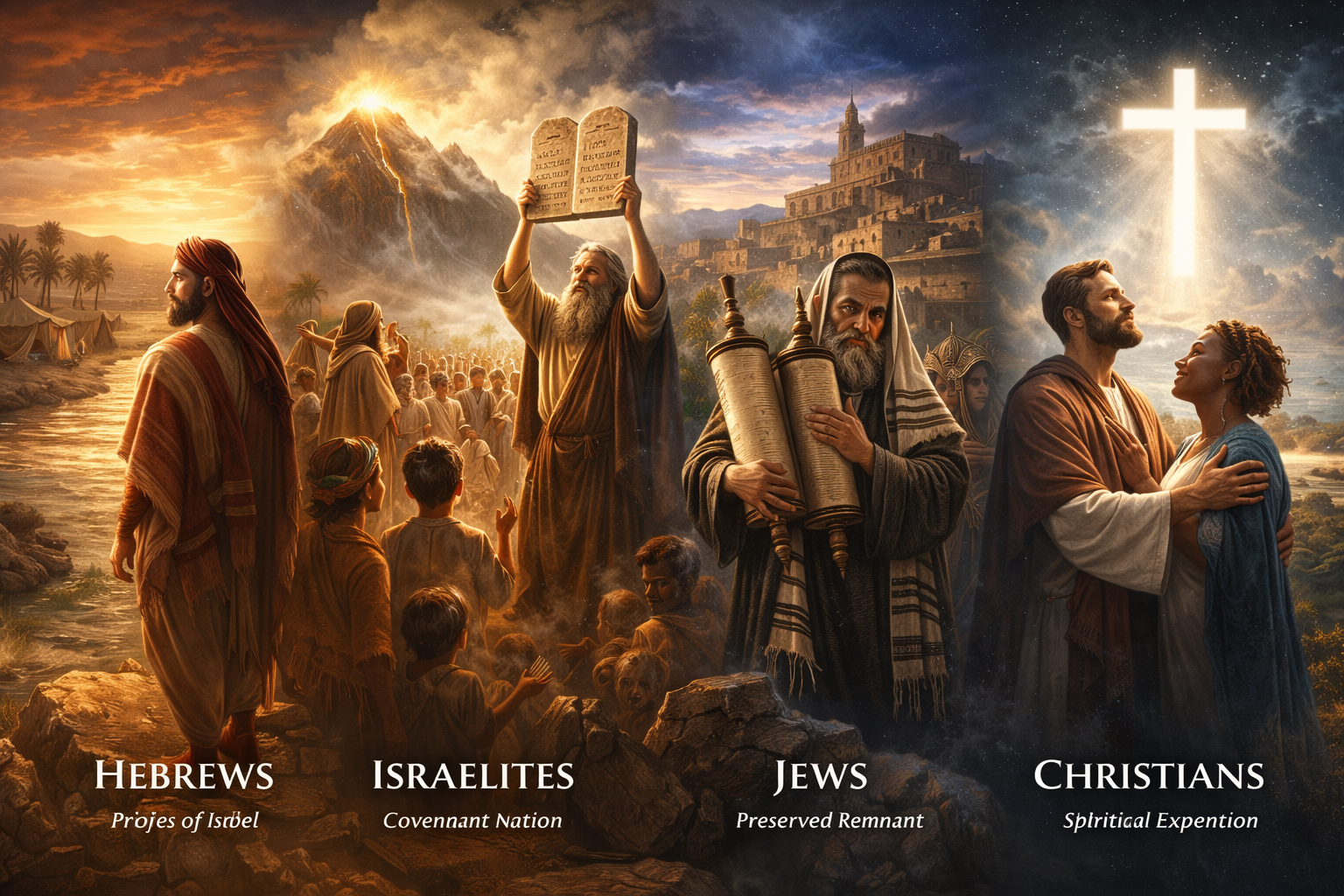
Hebrews: The People Who “Crossed Over”
The earliest term used in the Bible is Hebrew. It first appears in Genesis 14:13 when Abram is described as Abram the Hebrew.
The word Hebrew comes from the Hebrew verb “avar,” which means to cross over. At a basic level, it refers to Abraham crossing the Euphrates River on his journey to Canaan.
But the meaning goes deeper than geography.
It also reflects a spiritual shift. Abraham left a world of idolatry and stepped into a life centered on faith in one God. In that sense, the Hebrews were people who had crossed over—not just physically, but spiritually.
Historically, the term “Hebrew” was often used by outsiders such as Egyptians, Philistines, and later the Romans. It described the ethnic and linguistic identity of Abraham’s descendants.
So at this stage, the focus is origin—the family line that began with Abraham.
Israelites: The Covenant Nation
The next identity appears with the term Israelite.
This shift happens through Abraham’s grandson, Jacob. After wrestling with God at Peniel, Jacob’s name was changed to Israel, which means one who struggles with God.
From that moment on, Jacob’s descendants were known as Israelites.
Jacob had twelve sons, and each of them became the ancestor of one of the twelve tribes of Israel. This is where the identity moves from a family lineage to a national identity.
The Israelites were not just descendants of Abraham. They were the covenant nation formed at Mount Sinai, where they received the Law of Moses.
Later in history, after the reign of King Solomon around 930 BCE, the kingdom split into two parts.
The Northern Kingdom, called Israel, consisted of ten tribes. It was conquered by Assyria in 722 BCE, and many of its people disappeared into history—often referred to as the “Lost Tribes.”
The Southern Kingdom, called Judah, included the tribes of Judah and Benjamin, along with many Levites.
This southern kingdom would play a crucial role in the next stage of identity.
Jews: The Preserved Remnant
The word Jew comes from Judah.
After the northern kingdom was destroyed, the southern kingdom of Judah remained. Over time, the people who belonged to this surviving community began to be called Jews.
Originally the term referred specifically to people from the tribe of Judah. But as history unfolded—especially after the Babylonian exile—it expanded to include the entire surviving covenant community.
This is why someone like Mordecai in the Book of Esther, who was from the tribe of Benjamin, is still called a Jew.
By the time we reach the New Testament, the term “Jew” had become the standard name for the people of the covenant.
Jesus Himself was born, lived, and died as a Jew. He came from the line of David, which belonged to the tribe of Judah.
So the identity of a Jew represents the continuing remnant of Israel, the people who preserved the covenant and awaited the coming of the Messiah.
How These Identities Relate to Each Other
These three terms—Hebrew, Israelite, and Jew—are connected, but they operate at different levels.
The identity begins broadly with Hebrews, referring to the descendants of Abraham. It then narrows to Israelites, meaning the descendants of Jacob and the twelve tribes. Finally, it becomes more specific with Jews, referring primarily to the surviving community connected to Judah.
In simple terms, every Jew is also an Israelite, and every Israelite is also part of the Hebrew lineage. But not every Hebrew descendant belongs to Israel—for example, the descendants of Ishmael or Esau.
Christians: The Spiritual Expansion
The final stage appears with the emergence of Christianity.
Unlike the previous identities, which are tied primarily to physical descent and the Mosaic Law, the identity of a Christian is based on faith and spiritual rebirth.
Christians believe that Jesus Christ is the promised seed of Abraham through whom the blessing of God extends to all nations.
In the New Testament, the Apostle Paul explains that belonging to God’s covenant is no longer determined only by biological lineage. In passages such as Romans 2 and Romans 9, he argues that true belonging to God involves a transformation of the heart.
Paul writes that those who place their faith in Christ become children of Abraham by faith, regardless of their ethnic background.
This idea forms the foundation of the New Covenant.
In this covenant, the dividing wall between Jew and Gentile is removed. The community of believers becomes a new spiritual family centered on Christ.
The Big Picture
Seen together, these identities tell the story of how the biblical narrative unfolds.
A Hebrew could say: I have crossed over into faith.
An Israelite could say: I belong to the nation formed from the twelve tribes.
A Jew could say: I belong to the preserved covenant people awaiting the Messiah.
A Christian says: I follow the Messiah and share in Abraham’s promise through faith.
Understanding these distinctions helps us see the internal logic of the Bible more clearly.
It reveals a God who remains faithful to a specific historical lineage, while at the same time opening the door for all humanity to enter the covenant through faith.
