
We are entering a strange moment in the digital age.
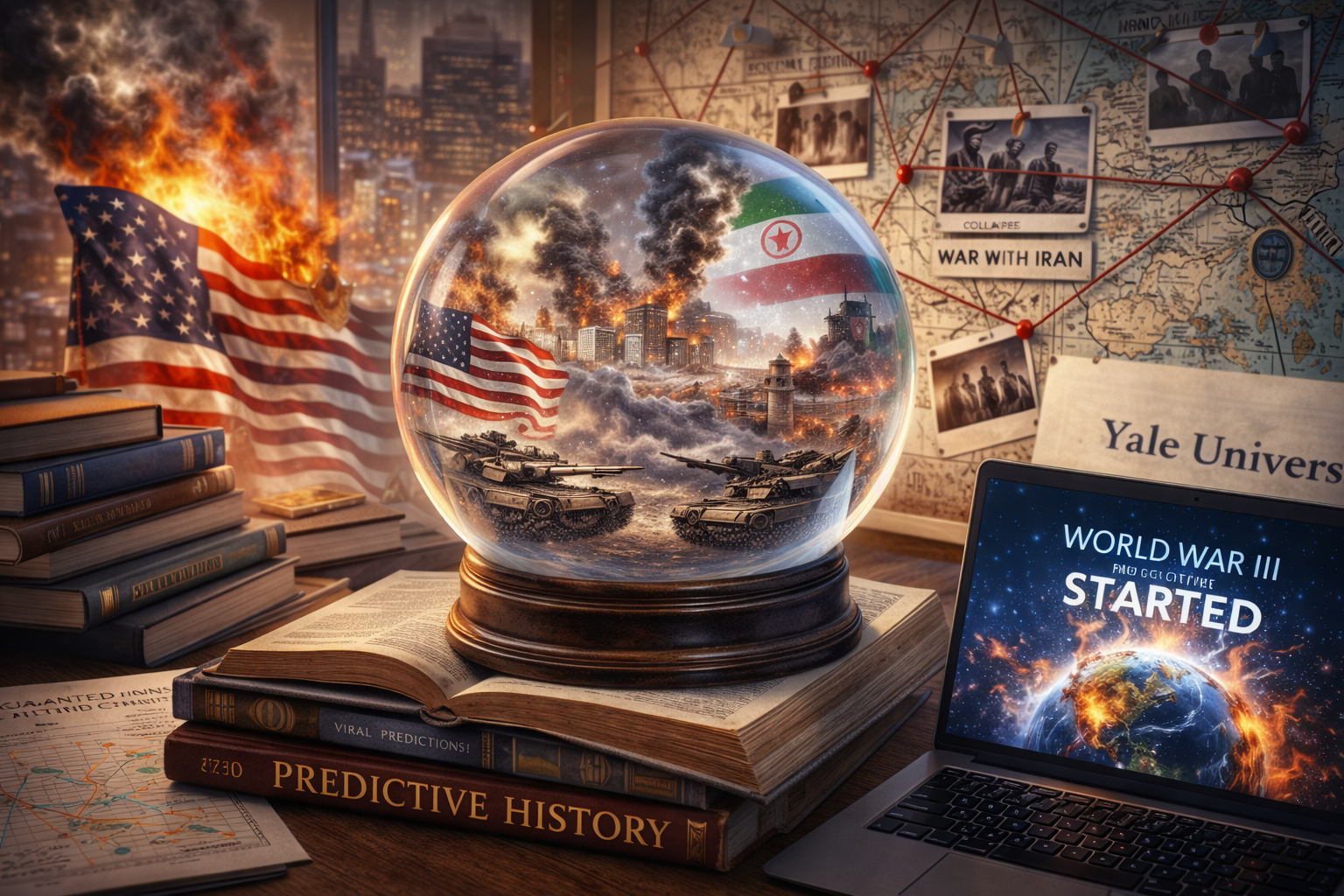
History is no longer just being studied. It is being used like a crystal ball. A growing number of viral academics now claim they can predict the future of global conflict. Some even argue that the collapse of the American empire is inevitable and will come through a war with Iran.
These predictions spread quickly online. They sound confident, dramatic, and intellectually convincing.
But once you slow down and examine the logic, the story becomes far less certain.
The Credibility Illusion
Many of these predictions follow a familiar pattern.
A commentator correctly predicts one or two major events. Perhaps an election result or a political shift that already had a strong statistical chance of happening.
Once that prediction comes true, something interesting happens. The commentator gains a reputation as a prophet. Their credibility multiplies overnight.
This is a classic psychological effect. When someone appears correct once, people begin to assume they will be correct again.
Prestigious academic credentials also play a role. A degree from an institution like Yale or Harvard can give an argument the appearance of deep academic authority. But a university name does not automatically turn a personal theory into rigorous analysis.
Sometimes it simply becomes a shield that protects bold claims from serious scrutiny.
The Geography Argument
One of the most common arguments behind these predictions is the comparison with Afghanistan.
The logic goes like this. Iran has mountains, a large population, and complex terrain. The United States struggled in Afghanistan. Therefore the United States would inevitably fail in Iran.
At first glance, this sounds reasonable.
But it assumes something very important. It assumes that a modern conflict would look like a long occupation war from the twentieth century.
That assumption may not hold.
Modern warfare increasingly relies on precision strikes, cyber disruption, economic pressure, and intelligence dominance rather than large scale ground occupations.
Predicting a total defeat based only on terrain and population ignores the technological gap between countries and the internal vulnerabilities that many states face.
History can offer lessons. But copying old scenarios too directly can lead to flawed conclusions.
The World War Three Narrative
Another trend is the growing claim that World War Three has already begun.
This language spreads quickly online because it creates urgency and fear. But it often exaggerates what are actually regional conflicts and geopolitical tensions.
Calling every escalation the start of a global war is not analysis. It is storytelling designed to capture attention.
When the narrative becomes dramatic enough, nuance disappears. Diplomatic possibilities get ignored. Every event is framed as confirmation that global collapse is inevitable.
That approach may generate clicks, but it does not produce careful historical thinking.
The Proxy War Argument
Many predictions also emphasize proxy warfare. Groups like Hezbollah or the Houthis are often described as strategic tools that Western countries supposedly cannot understand.
In reality, proxy warfare is not a new concept. It has been part of global strategy for decades. The Cold War was filled with proxy conflicts.
The challenge for large powers is usually not a lack of understanding. It is political calculation. Governments often weigh costs, alliances, public opinion, and long term consequences before responding.
Predicting the collapse of a global power based only on regional proxy conflicts overlooks the resilience of international alliances, financial systems, and military coordination.
The Real Lesson
History is powerful when it helps us understand patterns and limits.
But when history is used as a tool to predict the future with certainty, it stops being scholarship and starts becoming performance.
Empires do not collapse simply because someone predicted it on a podcast or social media thread.
Extraordinary claims require extraordinary evidence.
A few lucky predictions about elections do not suddenly turn history into prophecy.
And in the digital age, the loudest prediction is often the least reliable one.
