
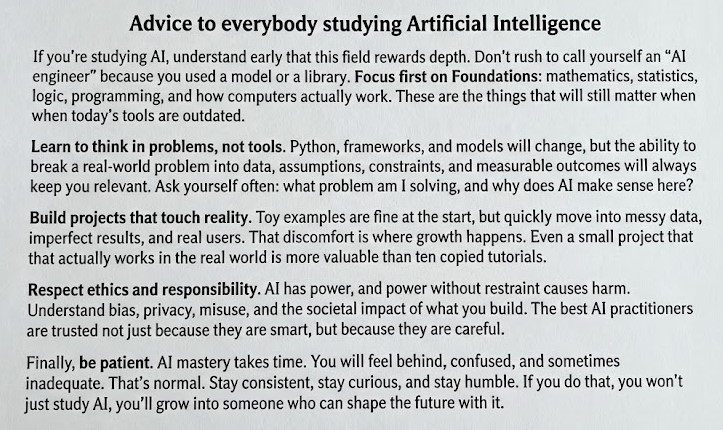
The provided advice for AI students is a classic “foundationalist” manifesto. It is intellectually sound and morally grounded, but in the current hyper-accelerated tech landscape, it borders on the idealistic. If we look at this advice through a more critical, market-driven lens, several gaps emerge.
Here is a critical analysis of the “Slow and Steady” approach to AI education.
1. The “Fundamentals” Trap: Theory vs. Utility
The text argues that math and logic are the only things that will matter when tools become outdated.
The Critique: While foundational knowledge is the “bedrock,” the market currently rewards functional abstraction. An engineer who can expertly tune a RAG (Retrieval-Augmented Generation) pipeline using modern libraries is often more valuable to a startup than a mathematician who can derive backpropagation from scratch but hasn’t touched a cloud GPU.
The Reality: We are entering an era where “how the computer works” is increasingly hidden behind layers of sophisticated software. Over-investing in low-level foundations at the expense of high-level tool mastery can lead to academic paralysis.
2. The “Problem over Tools” Fallacy
The advice suggests that tools like Python and specific frameworks are secondary to “problem-solving.”
The Critique: In AI, the tool often defines the possible solutions. You cannot “think in problems” effectively if you don’t understand the latent capabilities of the latest models. Thinking about a “data problem” in 2022 is fundamentally different from thinking about it in 2026 because the tools (LLMs, Diffusion, Agents) have shifted the boundaries of what is solvable.
The Reality: Mastery of the tool is mastery of the problem-solving landscape.
3. The Ethics Gap: Individual vs. Institutional
The text places the burden of ethics on the individual practitioner (“The best practitioners are careful”).
The Critique: This is a romanticized view of “The Virtuous Engineer.” In the real world, ethics are often determined by corporate incentives and institutional guardrails. A junior AI engineer “respecting privacy” has very little power if the company’s business model depends on data harvesting.
The Reality: Teaching students individual ethics without teaching them how to navigate corporate power structures and regulatory compliance is setting them up for a moral crisis they aren’t equipped to handle.
4. The Patience Paradox
“AI mastery takes time… be patient.”
The Critique: In a field where the state of the art changes every 3 to 6 months, patience can be a liability. If you spend two years “patiently” mastering the intricacies of a specific architecture, that architecture might be obsolete by the time you’re ready to “shape the future.”
The Reality: The modern AI student needs “Aggressive Agility” rather than “Patience.” You must learn to build while you are still confused, or you will be left behind by those who are comfortable with “good enough” results at high speeds.
