
Education is standing on a railway track, staring straight at the headlights of a speeding train, and arguing about whether to shout stop.
That train is generative AI.
For decades, the classroom has traded in the same currency memorized facts and the five paragraph essay. Today, that currency has collapsed in value. Not slowly. Instantly.
If we are being honest, the fear among educators is not really about cheating. It is about something more uncomfortable. A teaching model that has barely changed since the industrial era is suddenly exposed as outdated.
And the ground is shifting faster than anyone expected.
Why Banning AI Is a Dead End
The first reaction to AI in schools was prohibition.
Ban it. Block it. Detect it.
This led to a rush of AI detection tools designed to catch students using chatbots. But this approach was doomed from the start. As language models improve, their output becomes indistinguishable from human writing. The signal fades into the noise.
Trying to ban AI today is like banning calculators in a math exam or banning Google in a research lab. It assumes education is about effort for effort’s sake, rather than understanding.
Education was never meant to reward suffering. It was meant to reward mastery.
We Have Been Here Before
This moment feels dramatic, but it is not new.
Penmanship was once a full subject. Today it barely matters because keyboards took over.
Students once spent months memorizing the periodic table. Now that information is seconds away.
Long division is still taught for understanding, but no engineer performs serious calculations by hand anymore. They use tools.
We did not become less intelligent by letting go of these skills. We freed mental space to focus on deeper thinking.
AI is simply the next step in that same progression.
The Most Important Argument Is Equity
The strongest case for AI in education is not speed or convenience. It is fairness.
Traditional classrooms are built for the average student. If you learn faster, you wait. If you learn slower, you fall behind. A teacher with thirty students cannot give thirty different lessons at the same time.
AI can.
It is an infinitely patient tutor. It does not get tired when a student asks why again. It can explain the same idea ten different ways until something clicks. It can adjust instantly to how a student thinks.
This does not replace the teacher. It elevates them.
The teacher shifts from being a lecturer to being a mentor, a guide, and an ethical anchor.
What Students Actually Need to Learn Now
If a machine can write the essay and solve the equation, what is left for the student
Thinking.
In a world where answers are cheap, questions become valuable.
Education must move toward new priorities.
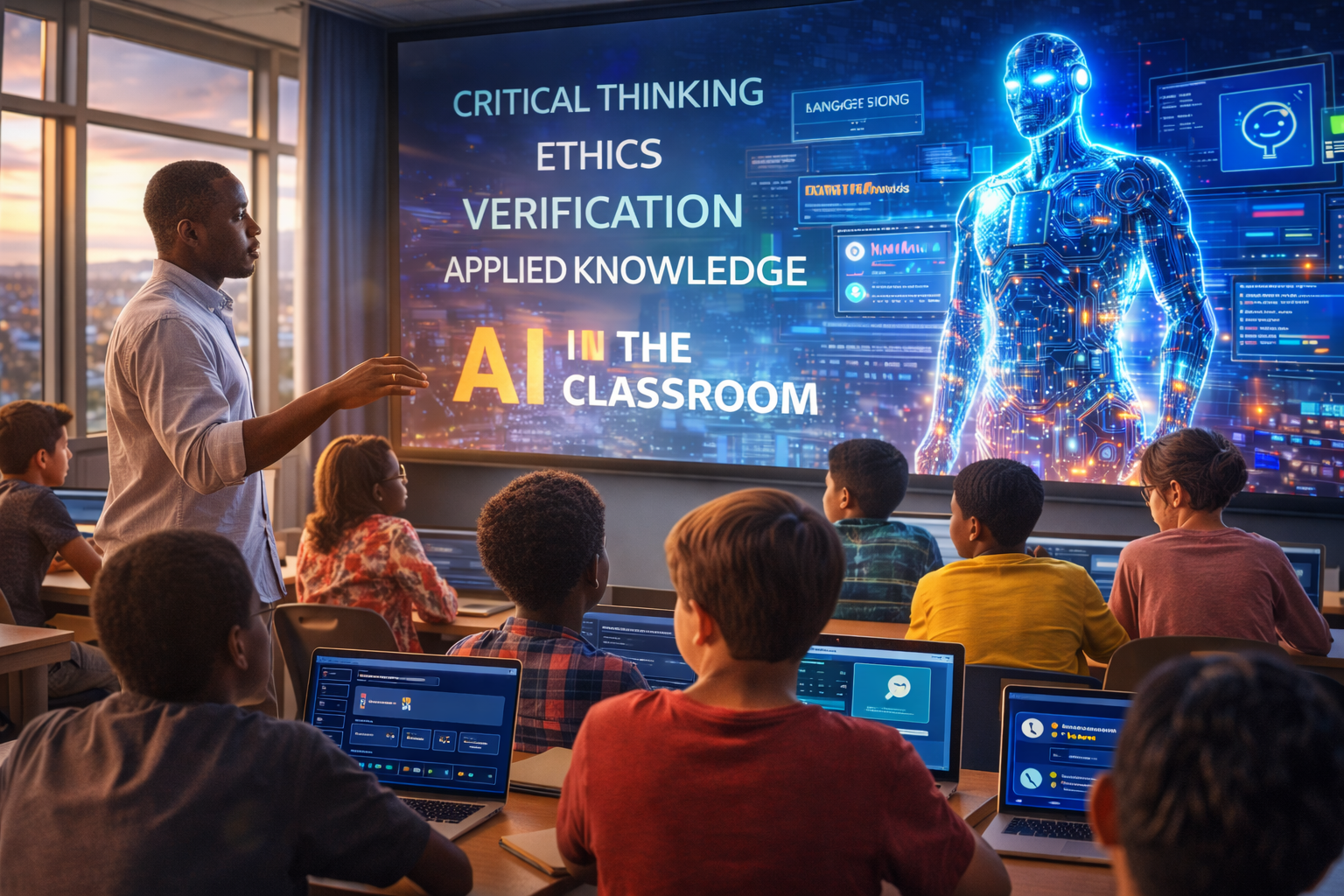
Students must learn how to verify AI output and detect errors or bias.
They must understand the ethical consequences of automated decisions.
They must learn how to apply knowledge using AI as a tool, not a crutch, preparing for debates, projects, and real world problem solving.
The future belongs to those who know how to think with machines, not those who try to compete against them.
Preparing for the Present
The workplace will not reward someone who can produce work without assistance. It will reward those who can use AI to amplify their impact.
Refusing to teach AI literacy does not protect academic integrity. It creates graduates who are unprepared for the world they are entering.
The train is not coming.
It has already arrived.
The only question left is whether we teach students to fear it or teach them how to drive it.
