
For years, Nollywood producers have played the same game.
Make a big film.
Fight for limited cinema screens.
Negotiate with powerful distributors.
Pray your movie doesn’t get pushed aside by a bigger title.
It’s a system that rewards scale, connections, and deep pockets. And for most filmmakers, there’s no real alternative.
Except Femi Adebayo decided not to play that game at all.
Instead of competing in the crowded cinema market, he walked away from it—quietly—and built his own distribution path. And surprisingly, it worked.
But here’s the real question:
Was this a reckless gamble… or a strategic masterstroke?
Breaking Away from the Cinema Crowd
Nollywood has entered a new phase of competition.
Big-budget films now fight over a small number of cinema screens. Screen time is limited. Ticket prices are rising. Smaller producers are often squeezed out. Even established names struggle to secure long, profitable runs.
Femi Adebayo saw the writing on the wall.
Rather than entering the “red ocean” of cinema battles, he chose a blue ocean strategy—one where competition becomes irrelevant because the rules change.
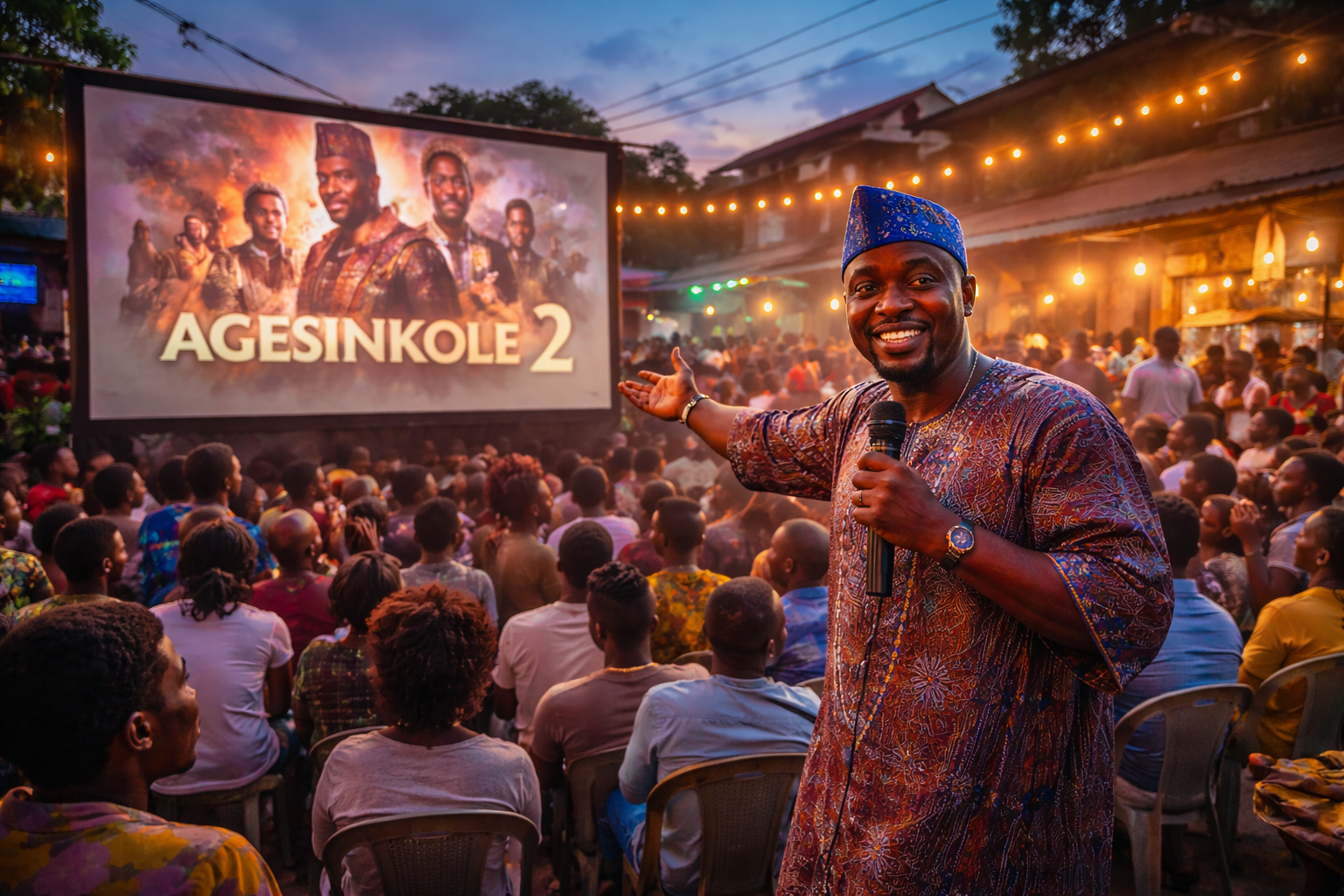
With Agesinkole 2, he bypassed traditional cinemas and took the film directly to the people using a traveling, community-based screening model.
This wasn’t random experimentation.
It was a return to Nollywood’s roots.
A Return to Communal Cinema
Before malls and multiplexes, Nollywood thrived in community halls, open spaces, and neighborhood viewing centers.
Pioneers like Hubert Ogunde built their audiences by meeting them where they lived. Films were social events. Cultural gatherings. Shared experiences.
Femi Adebayo didn’t invent something new.
He revived something old.
His father, Adebayo Salami, used similar grassroots distribution decades ago. What Femi did was modernize it—with social media marketing, digital ticketing, and modern production quality.
It was tradition, upgraded.
The Economics: Was It Really Risky?
On paper, abandoning cinemas looks dangerous.
Cinemas offer structure.
They offer visibility.
They offer a familiar revenue model.
But they also come with heavy costs:
- High distribution fees
- Revenue splits that favor exhibitors
- Scheduling politics
- Limited access outside major cities
By stepping outside that system, Adebayo changed the economics entirely.
Within 12 days, Agesinkole 2 reportedly grossed over ₦417 million.
How?
1. Affordable Pricing
Tickets were sold for around ₦3,000–₦4,000.
That’s far below the average cinema ticket price in urban malls.
This instantly expanded his audience base to include:
- Students
- Low-income earners
- Rural and semi-urban communities
- Families who avoid cinemas due to cost
Lower price.
Higher volume.
Wider reach.
2. Strategic Local Venues
Instead of malls, screenings were held in community-friendly locations.
This did three things:
- Reduced venue costs
- Created a festival-like atmosphere
- Boosted local vendor participation (food sellers, merch, transport)
It turned movie night into a community event.
3. Bypassing the Gatekeepers
By skipping cinema chains, Adebayo avoided:
- Heavy revenue cuts
- Release scheduling delays
- Marketing restrictions
This meant higher margins per ticket, even at lower prices.
So was it risky?
Yes.
But it was calculated risk, not blind risk.
The Real Advantage: Community Power
Here’s the part most analysts miss.
Femi Adebayo is not just a filmmaker.
He is culturally embedded.
He speaks the language of his audience.
He understands their values.
He carries legacy credibility from his father.
This gives him something cinemas don’t have: trust capital.
People didn’t just buy tickets for Agesinkole 2 because of advertising.
They bought tickets because:
- They felt personally invited
- They saw him as “one of us”
- They wanted to support “their own”
This is community economics at work.
And it’s incredibly hard to copy.
Is This Model Sustainable?
This is where the real analysis begins.
Femi Adebayo’s strategy is brilliant—but it’s not universally safe.
What Makes It Strong
- Mass Market Reach
Nigeria has over 200 million people and barely over 100 functional cinema screens.
The math alone makes alternative distribution logical. - Lower Operating Costs
Community venues are cheaper than malls.
Marketing is driven by social buzz, not expensive ad campaigns. - Higher Revenue Control
More direct sales = better margins. - Cultural Differentiation
This model fits indigenous-language films especially well.
What Makes It Risky
- Operational Complexity
Traveling screenings require logistics, security, scheduling, and equipment management.
Scaling this nationwide is not trivial. - Piracy Exposure
Non-cinema environments increase the risk of illegal recordings. - Quality Control Issues
Sound, visuals, and seating quality can vary across locations. - Brand Dependence
This model works best for celebrities with loyal fan bases.
It may fail for unknown producers.
So no—this is not a universal replacement for cinemas.
But yes—it is a viable parallel distribution channel.
What This Means for Nollywood’s Future
Femi Adebayo didn’t destroy cinema distribution.
He weakened its monopoly.
And that’s the real disruption.
He proved that:
- Box office success doesn’t require mall cinemas
- Distribution power can shift back to creators
- Community-driven models can outperform centralized systems
- Indigenous storytelling still has massive untapped demand
We’re already seeing echoes of this shift:
- Jagun Jagun thriving on Netflix
- Bolanle Austen-Peters building private viewing venues
- Producers experimenting with hybrid release models
This isn’t chaos.
It’s decentralization.
Final Verdict: Risky or Revolutionary?
Femi Adebayo’s move was not reckless.
It was strategic, historical, and market-aware.
He didn’t bet against cinemas.
He bet against dependence on cinemas.
And he won.
The real lesson isn’t that every producer should copy him.
The lesson is this:
In a broken distribution system,
the bold don’t wait for permission.
They build new roads.
Reference Table
| Claim / Topic | Source | Year | Notes |
|---|---|---|---|
| Nigeria cinema screen count (approx. 100–150) | UNESCO Institute for Statistics; Nigerian Film Corporation | 2022–2023 | Confirms severe cinema scarcity |
| Nollywood’s early communal distribution history | Haynes, J. Nollywood: The Creation of Nigerian Film Genres | 2016 | Documents grassroots viewing culture |
| Rise of alternative film distribution models | Lobato, R. Shadow Economies of Cinema | 2012 | Global analysis of non-cinema distribution |
| Community-based cultural economics | Ostrom, E. Governing the Commons | 1990 | Explains trust-based collective participation |
| Blue Ocean Strategy framework | Kim & Mauborgne, Blue Ocean Strategy | 2005 | Strategic context for non-competitive markets |
| Nigerian streaming expansion (Jagun Jagun, Netflix) | Netflix Africa Press Releases | 2023 | Confirms Nollywood’s platform diversification |
| Indigenous language film market growth | PwC Africa Entertainment Outlook | 2023 | Supports market demand trends |
