
Solar energy is no longer optional.
It is now a core part of the global fight against climate change.
It produces some of the lowest carbon emissions of any energy source. And more importantly, it has become incredibly cheap. In many parts of the world, solar power now delivers some of the lowest electricity costs ever recorded—even when storage is included.
But behind this affordability sits one undeniable reality.
Solar power today runs on China.
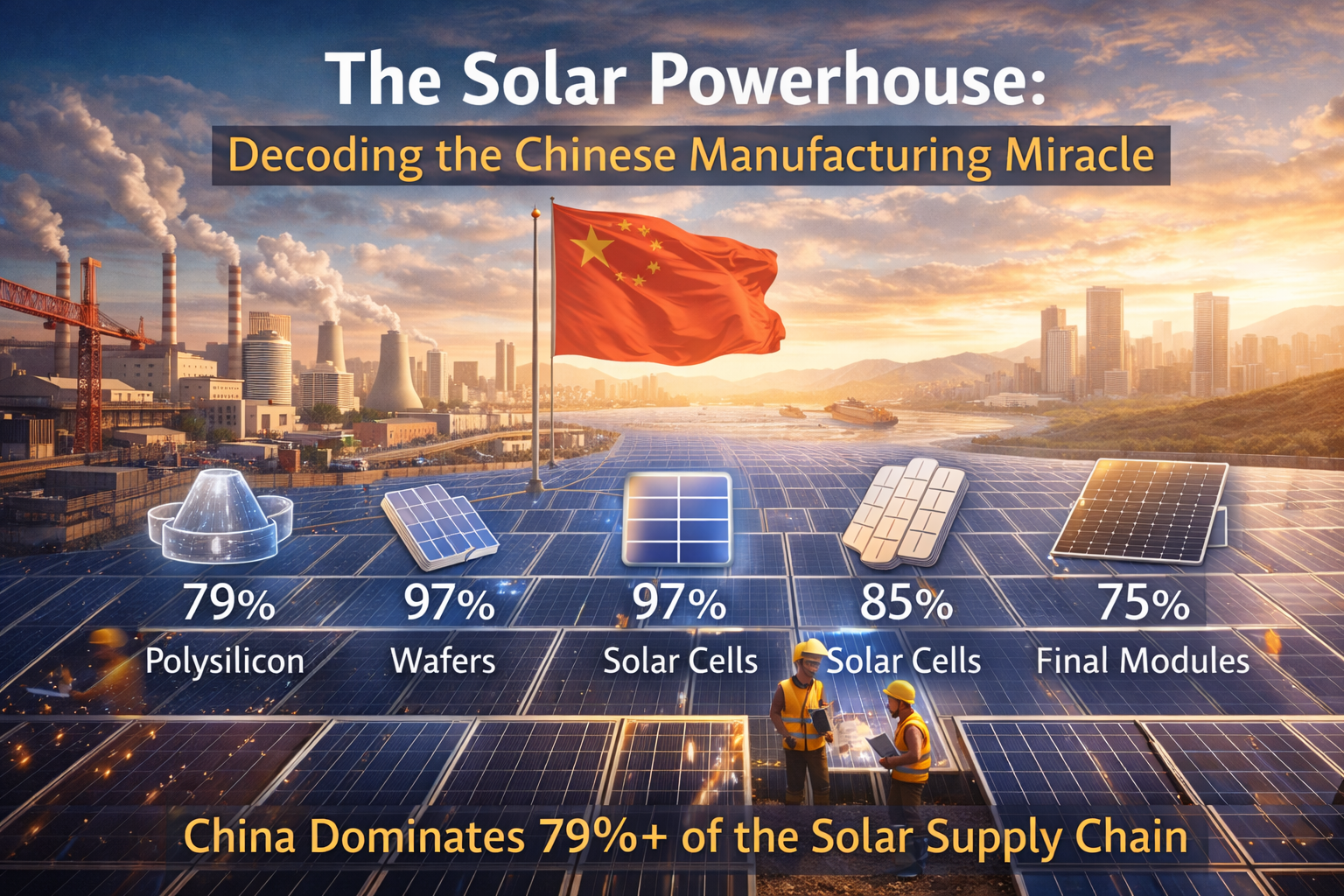
Nearly the entire global solar industry depends on Chinese manufacturing. This dominance has made solar accessible—but it has also made governments uneasy. To understand where global energy is heading, we need to understand how China became the world’s solar factory.
The Scale Advantage
China’s biggest strength is scale.
It can manufacture more than 1,000 gigawatts of solar panels every year—far more than the world currently installs. That oversupply drives prices down aggressively.
Competition inside China is intense. Manufacturers race to cut costs, improve efficiency, and survive on razor-thin margins. The result is cheap solar for the rest of the world.
Control of the Entire Supply Chain
China’s dominance isn’t just about factories.
It controls almost every step of solar production.
Most of the world’s polysilicon is produced in China.
Nearly all solar wafers are made there.
The majority of solar cells come from Chinese plants.
And most finished solar panels are assembled there too.
When one country controls the raw materials, the components, and the final product, it controls the price.
The Power of Industrial Clusters
Another secret is proximity.
China builds entire regions around one industry. Suppliers, machine builders, engineers, and manufacturers all operate side by side.
This creates speed.
If a company needs new equipment, it doesn’t wait months. A nearby supplier builds it in days. If one company improves a process, others adapt quickly.
Innovation spreads fast—not because ideas are stolen, but because ecosystems are tightly connected and highly responsive.
Policy, Infrastructure, and Workforce
This success is not accidental.
The Chinese government made solar a strategic priority. It backed the industry with subsidies, tax incentives, and long-term planning.
It invested heavily in infrastructure—transportation, power, logistics, and communications—so factories could operate efficiently.
China also benefits from a massive pool of technically trained workers. Engineers and technicians are produced at scale, disciplined, and deployment-ready.
Together, these factors create a manufacturing engine that is hard to match.
Ethics, Risk, and the Road Ahead
China’s solar industry has faced serious scrutiny—especially around environmental impact and labor practices. While regulations are tightening and automation is increasing, transparency remains a concern for global partners.
The future of clean energy will depend on more than cheap panels.
It will depend on building complete value ecosystems—from ethical sourcing and manufacturing to recycling and circular supply chains.
Solar power can change the world.
But only if the green revolution is not just affordable—but also fair, transparent, and sustainable.
References (published sources)
- International Energy Agency (IEA). (2023). World Energy Outlook and Special Report on Solar PV Global Supply Chains.
- Fraunhofer Institute for Solar Energy Systems (ISE). (2023). Photovoltaics Report.
- BloombergNEF. (2023). Global PV Market Outlook.
- U.S. Department of Energy. (2024). Solar Energy Technologies Office – Supply Chain Analysis.
- International Renewable Energy Agency (IRENA). (2022). Renewable Power Generation Costs.
