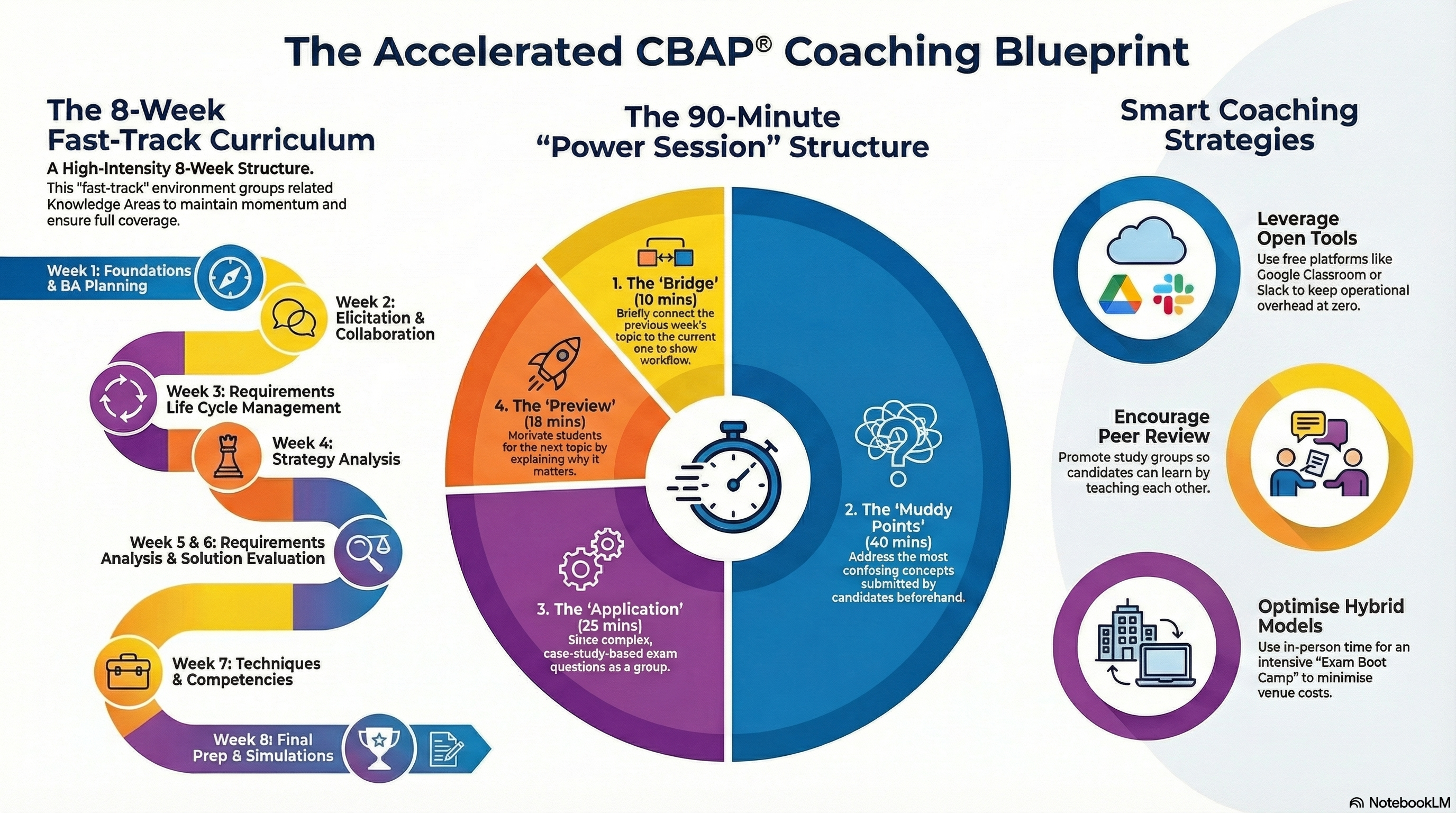
The Problem with Most CBAP Trainings
Most CBAP preparation programs make the same assumption:
If candidates are exposed to enough BABOK content, success will follow.
Yet year after year, experienced business analysts—people with real-world competence—fail the CBAP exam. Not because they lack experience, but because the exam does not reward memorization. It rewards interpretation, judgment, and structured thinking aligned with BABOK logic.
The gap is not knowledge.
The gap is sense-making.
The BABOK itself is explicit that business analysis competence is demonstrated through application, not recall (IIBA, 2015). Unfortunately, many training programs still rely on lecture-heavy, slide-driven delivery models that leave candidates alone with their confusion after class.
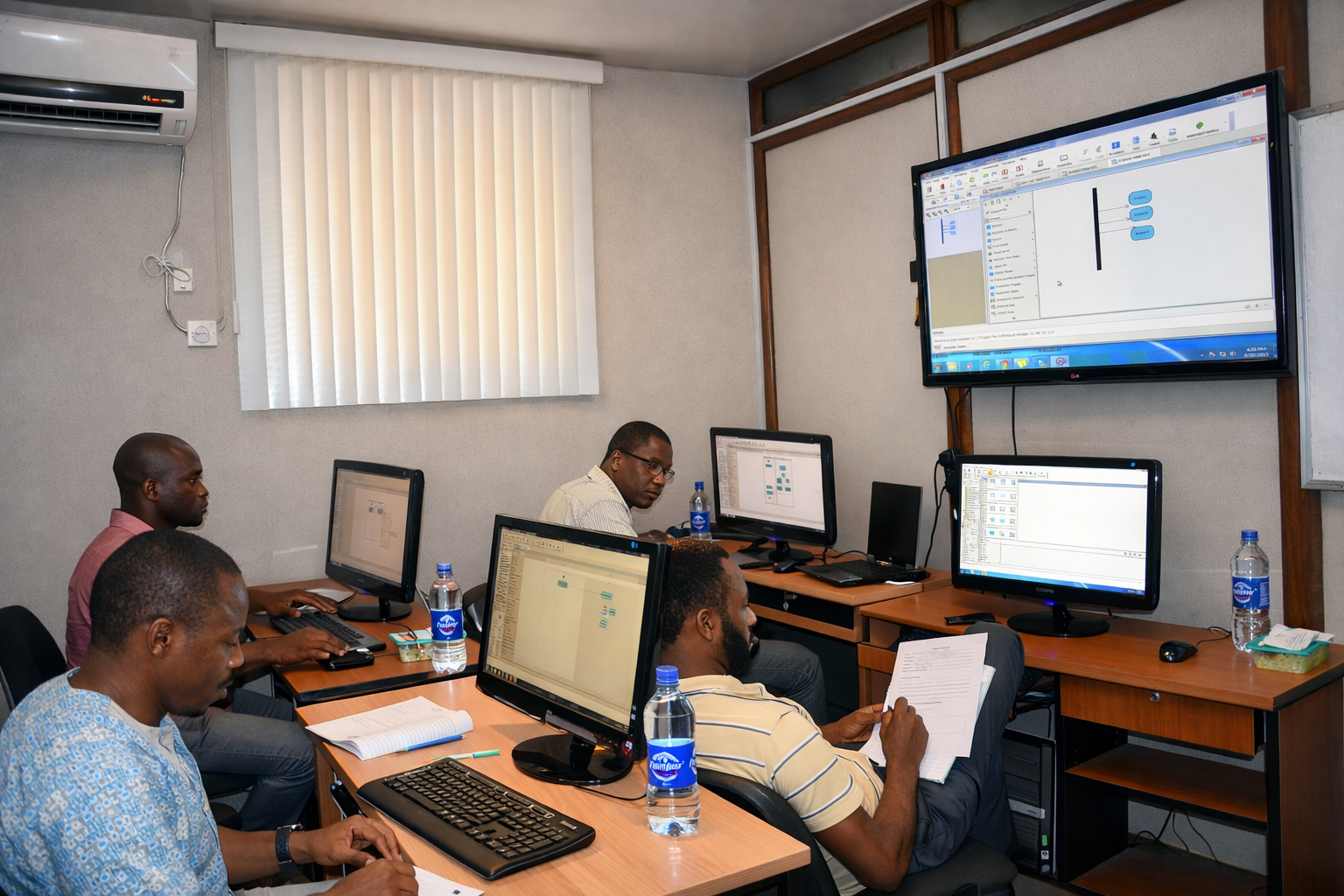
A Different Approach: Coaching, Not Content Delivery
This CBAP preparation program is intentionally designed around a coaching-first model.
Instead of long lectures, candidates are given:
- A clear weekly topic
- Carefully curated study materials
- Time to engage independently during the week
The live component—held every Saturday—is not for teaching slides. It is for:
- Clarifying misunderstandings
- Connecting concepts across BABOK knowledge areas
- Reframing how the exam expects candidates to think
This approach reflects well-established findings in adult learning research: experienced learners benefit more from guided reflection and problem-centered discussion than from passive instruction (Knowles et al., 2015).
Why the Program Runs on Weekends (8 Weeks)
CBAP candidates are working professionals. Cognitive overload is a real risk.
By spreading the program across 8 weekends, the design leverages distributed practice, a learning strategy shown to significantly improve long-term retention and transfer compared to massed learning or bootcamps (Cepeda et al., 2006).
Each week builds on the previous one, allowing candidates to:
- Internalize BABOK concepts gradually
- Recognize recurring patterns across knowledge areas
- Reduce last-minute cramming, which is ineffective for scenario-based exams
What Happens in the 90-Minute Saturday Session
Each live session is deliberately structured around three goals:
- Synthesis of the Week
Not a recap, but a conceptual consolidation—how this topic fits into the larger BABOK ecosystem. - Candidate-Driven Clarification
Real questions, real confusion, real scenarios. This is where coaching matters most. - Framing the Next Topic
Candidates leave knowing not just what to study next week, but why it matters and how it connects.
This design reflects the principle of scaffolded learning, where expert guidance gradually refines learners’ mental models (Ericsson et al., 1993).
Why This Is Affordable—Without Being Cheap
Affordability here is not about reducing value; it’s about removing inefficiency.
There is no redundant lecturing.
There are no recycled slide decks.
There is no time spent on what candidates can already read.
What candidates pay for is
- Interpretation
- Exam-aligned thinking
- Feedback
- Confidence calibration
Research on expert performance consistently shows that deliberate practice with expert feedback is what leads to mastery—not repetition alone (Ericsson et al., 1993).
Who This Program Is (and Is Not) For
This coaching program is ideal for:
- Practicing business analysts with real experience
- Candidates who have studied BABOK before but feel “stuck.”
- Professionals who want clarity, not content overload
It is not designed for:
- Passive learners
- Candidates looking for shortcuts
- Those expecting someone to “teach BABOK line by line.”
Closing: Coaching Candidates to Success, Not Just Certification
CBAP is not an academic exam. It is a professional judgment exam.
Preparing for it requires more than exposure—it requires guided sense-making.
This program exists to coach candidates into thinking as the exam expects, while respecting their time, experience, and constraints.
That difference is intentional.
Another batch begins Feb 7th.

Please make payment to Access Bank 0006551542, Poet Solvers Ltd., and send the receipt to pmtutor@ng at gmail.com to reserve your seat.
References
- Cepeda, N. J., Pashler, H., Vul, E., Wixted, J. T., & Rohrer, D. (2006). Distributed practice in verbal recall tasks: A review and quantitative synthesis. Psychological Bulletin, 132(3), 354–380.
- Ericsson, K. A., Krampe, R. T., & Tesch-Römer, C. (1993). The role of deliberate practice in the acquisition of expert performance. Psychological Review, 100(3), 363–406.
- International Institute of Business Analysis (IIBA). (2015). A Guide to the Business Analysis Body of Knowledge (BABOK® Guide), Version 3.
- Knowles, M. S., Holton, E. F., & Swanson, R. A. (2015). The Adult Learner (8th ed.). Routledge.