
If you want to understand what’s happening to work, start with the people who were always positioned as the “safe bets.” In the last two years, even elite MBA programs—traditionally viewed as automatic gateways into consulting, finance, and tech—have reported unusually weak placement outcomes. The Wall Street Journal has already noted that new graduates across the board are walking into the softest job market in more than a decade. And if the most credentialed group is struggling to secure roles, the signal for everyone else is unmistakable: the problem is structural, not seasonal.
The collapse of the entry-level pathway didn’t begin with AI, but AI is accelerating a process that has been playing out quietly for years. Before automation entered the conversation, young job seekers were already dealing with a distorted hiring ecosystem.
One part of that distortion is the rise of what many now call “ghost jobs.” Multiple investigations—including reporting by The Wall Street Journal and Bloomberg—have shown that companies often post roles they have no immediate plan to fill. Sometimes it is branding. Sometimes it is internal optics. Whatever the reason, it traps applicants in a cycle of applying to positions that look real but function more like placeholders.
Even when the role actually exists, the résumé rarely crosses a human desk. Applicant Tracking Systems (ATS)—now used by most medium and large companies—filter candidates long before a recruiter enters the picture. Research from the Harvard Business School’s Hidden Workers project has shown how automated filters routinely screen out qualified applicants based on rigid keyword rules, employment gaps, and formatting quirks. These systems don’t evaluate; they exclude.
This leads directly into the next contradiction: the idea of an “entry-level” job has become almost fictional. Studies from the National Association of Colleges and Employers and analyses by Burning Glass Institute have consistently shown that many junior roles now demand prior experience that beginners, by definition, cannot have. Internships were supposed to bridge that gap, yet competition has increased sharply—and a substantial share of internships remain unpaid, making them accessible to privilege, not potential.
This is the landscape AI has stepped into, and its impact is not restorative. It is amplifying the erosion.
The work that historically justified junior hiring—research, drafting, basic coding, summarization, data cleaning, initial analysis—is precisely the work now being delegated to AI systems. Reports from McKinsey & Company, Goldman Sachs, and the OECD have all warned that early-career, task-driven roles are among the most vulnerable segments of the workforce over the next decade. And many companies are already restructuring teams around a model that pairs automation with a smaller number of senior specialists.
Offshoring won’t resolve it; immigration policy won’t reverse it. The tasks that used to anchor early roles are simply being automated out of existence. The mechanism is new, but the displacement is not.
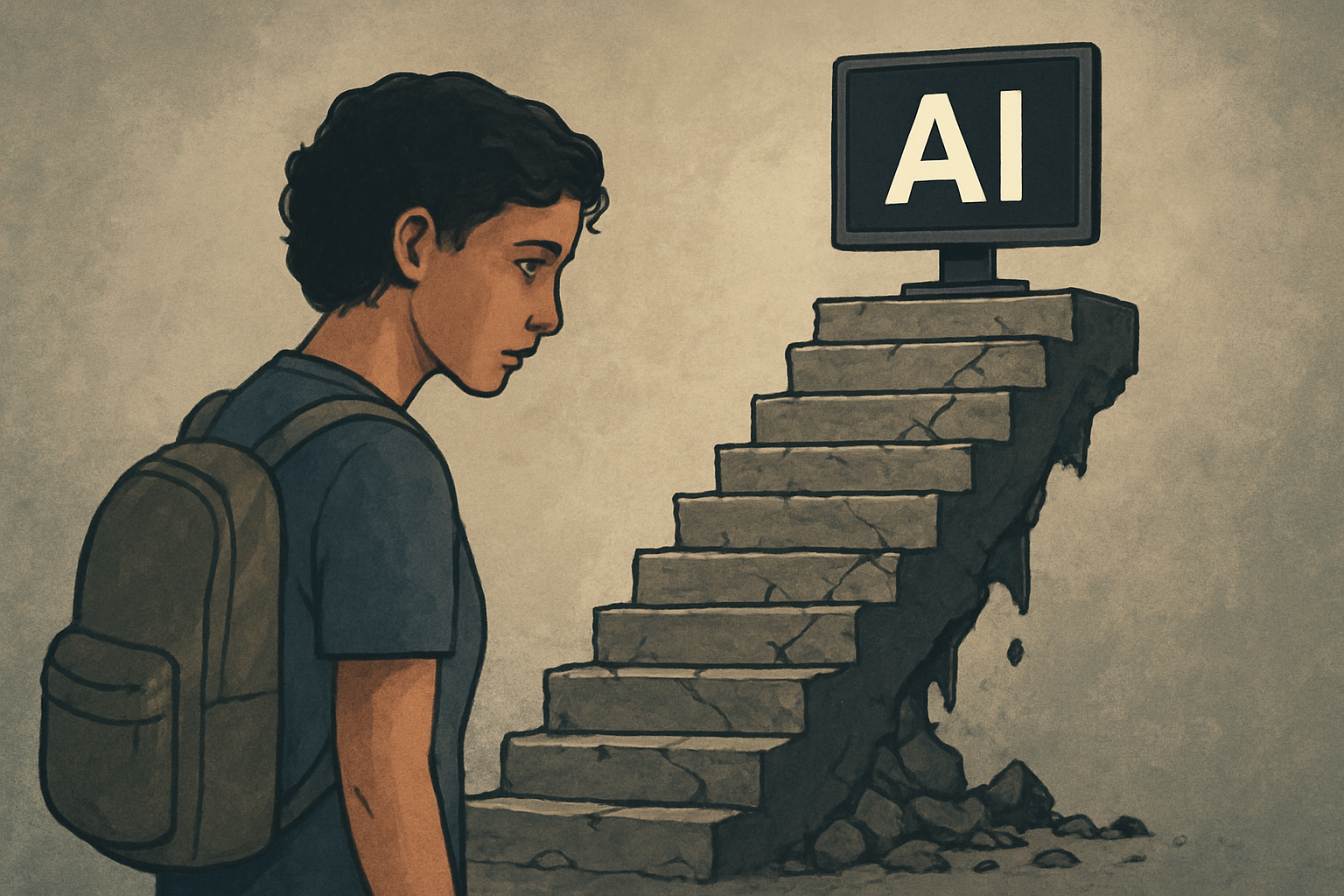
What we are seeing now is a generation that did everything society instructed—earned the degree, built the résumé, collected internships—yet still encounters sealed doors. Not because they failed, but because the foundational rung of the career ladder has been sawed off. AI didn’t cause that cut, but it is ensuring the ladder doesn’t get rebuilt.
This is not a temporary dip. It is a redesign. And in the new design, careers are no longer guaranteed to begin.
